
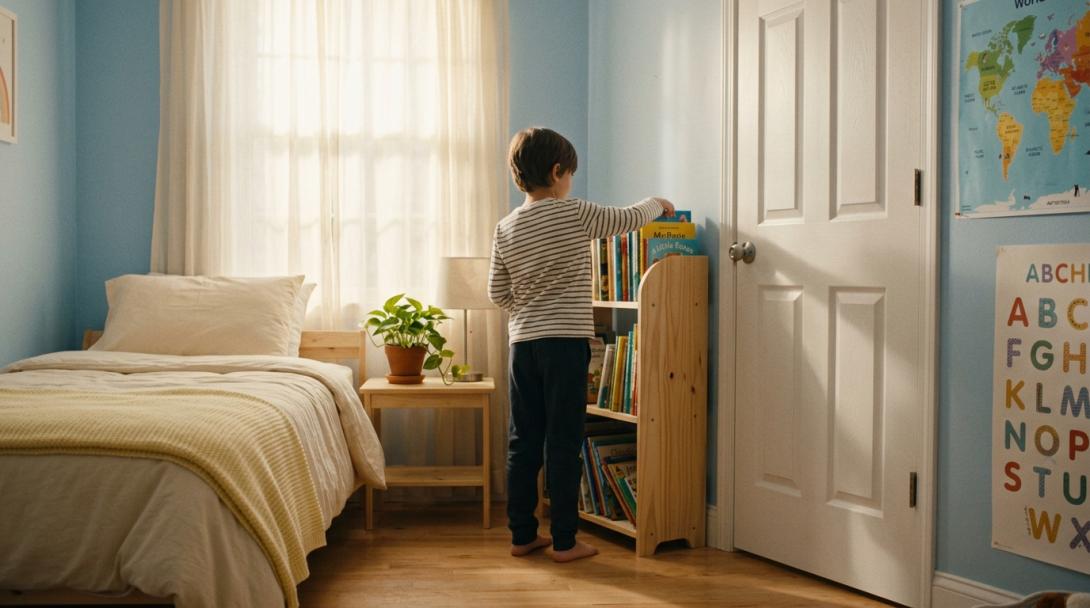
Every parent, at some point, wonders about their child.
Why is my daughter suddenly so anxious about school? Why does my son fight with his sister every single evening? Why does my child never seem to want to sleep alone? Why is my usually-cheerful little one now so moody, so tired, so easily upset?
We ask the pediatrician. We check for allergies, sleep issues, screen time patterns. We wonder if it's their friends, their teacher, hormones, growth spurts. We read parenting books, download focus apps, try new bedtime routines.
Sometimes we find the answer. Often, we don't.
Here's something most parents never consider: the room your child spends 10-12 hours a day in is quietly shaping their nervous system, their mood, their concentration, and their emerging personality — every single day.
We've written before about babies (baby sleep direction) and school-age children studying (study table Vastu). But between those two — from about age 4 to 14 — there's a critical window where your child's entire room, not just their bed or desk, is doing quiet, powerful work on who they're becoming.
Get their room right, and you're giving them a launchpad for calm, confidence, focus, and healthy sleep. Get it wrong, and even the best parenting effort has to swim against a subtle current every day.
Let me walk you through what Vastu Shastra teaches about children's rooms — the placement, the direction, the colors, the layout, and the small details that quietly shape who your child becomes.
Why Children's Rooms Matter More Than Adult Rooms
Adults have adapted. Our nervous systems have hardened to environmental noise over years — we can sleep in less-than-ideal directions, focus in cluttered spaces, and function in rooms that would derail a child.
Children haven't developed that armor yet.
A child's nervous system is still being built. Every night's sleep either strengthens or weakens it. Every hour spent in their room either supports or disrupts their emerging emotional regulation. Every color, every direction, every energy pattern in that room becomes part of who they're becoming.
This is why Vastu treats children's rooms with such care. In traditional Indian homes, elders would often personally choose which room a child slept in and how it was set up — not because they were controlling, but because they knew the room shaped the child.
Modern developmental psychology confirms this: environments affect children's cortisol levels, sleep quality, attention span, and emotional regulation more profoundly than they affect adults. Get the room right, and everything else in parenting gets easier.
Now let's talk about how.
Rule #1: The Ideal Room Position in the Home 🧭
Not every room in your home is equally suited to be a child's room.
Best directions for a children's room:
✅ West — The Ideal Zone
The West is associated with stability, learning, and healthy growth. It's a grounded, protective direction — perfect for a young mind that needs consistency and security.
✅ North-West — Excellent for Older Children
The North-West is associated with air and movement — great for children starting to develop independence (roughly ages 10+). It supports growing confidence and social skills.
✅ South-West — Good for Grounding
The South-West is stable and protective. Good for anxious children or children who need extra security.
✅ East — For Very Young Children
The East is auspicious for early childhood — supports vitality and morning-light exposure. Better for children under 8.
Directions to be cautious about:
❌ South-East (The Fire Zone)
Children's rooms in the South-East often produce more restless, argumentative, temperamental behavior. The "fire zone" energy is too intense for developing nervous systems. If your child's room is here, apply extra cooling remedies (soft colors, calming plants, minimal electronics).
❌ North-East (The Sacred Zone)
While divine and pure, the North-East is too energetically "active" for restful sleep. Better suited for a pooja space or study area, not a full bedroom.
❌ Center of the Home
Rooms in the Brahmasthan (center) should stay open and free — not turned into a child's bedroom.
If your child is currently in a suboptimal room: Don't panic. Consider whether room-swapping is possible. If not, the rest of this article will help you compensate with layout, direction, and color choices.
Rule #2: Sleep Direction — Head Should Point East or South 🛏️
This is one of the most impactful single choices you can make for your child.
Best sleep directions for children:
- ✅ Head pointing East — for younger children (under 10). Supports vitality and morning-fresh waking.
- ✅ Head pointing South — for children of all ages. Deep, restorative sleep. Traditional Vastu favorite.
Directions to avoid:
- ❌ Head pointing North — the same principle as adults, but even more pronounced in children. Their still-developing magnetic fields clash with the Earth's, causing restless sleep, frequent waking, and irritability.
- ❌ Head pointing West — acceptable for adults, but not ideal for growing children.
How to check:
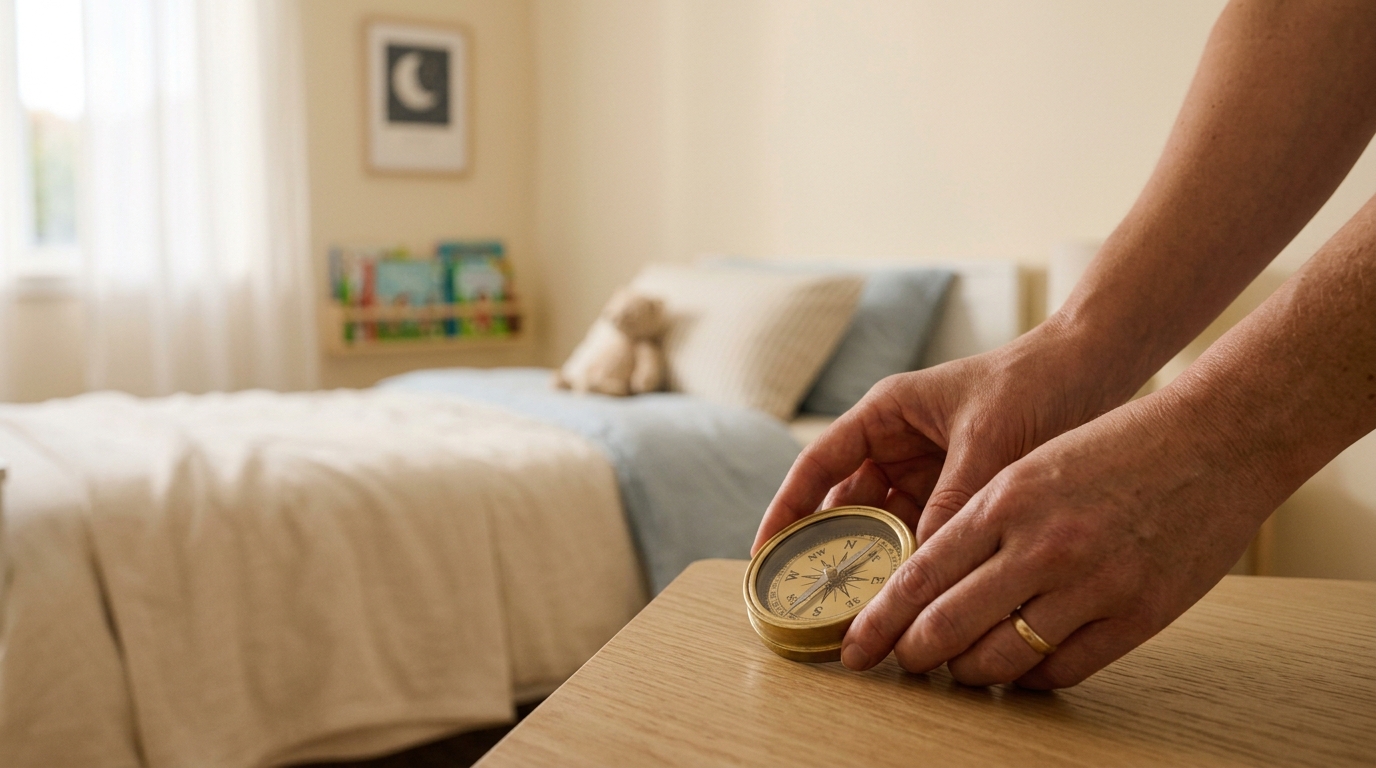
Stand at the foot of your child's bed. Where their head rests, use your phone's compass to check the direction. If the direction is North, rotate the bed. This one change often transforms sleep quality within 3-5 nights.
We covered the deeper science of sleep direction in our wake up tired article — worth reading if this is new to you.
Rule #3: Bed and Furniture Placement 🪑
Beyond direction, where the bed and furniture sit within the room shapes your child's day-to-day experience.
Best bed placement:
- Headboard against a solid wall (never a window)
- Ideally in the South-West corner of the room — the most protected, grounded position
- Diagonally across from the door so your child can see the door without being in direct line with it (the "command position")
- Some breathing space on both sides of the bed if possible
Bed placements to avoid:
- ❌ Bed under a window — energy exposure disrupts sleep
- ❌ Bed under a beam or sloping ceiling — creates literal energetic pressure on your child's small body
- ❌ Bed directly in line with the door — energy hits the child all night
- ❌ Bed with the head near a shared wall to a toilet — energetic contamination
- ❌ Bed with a mirror facing it — disturbs sleep and can create fear at night in younger children
Study desk placement:
- Facing East or North (we covered this in depth in our study table article)
- Solid wall behind the chair
- Away from the bed (so the room has clear "study zone" vs "sleep zone" separation)
Wardrobes and heavy furniture:
- Best placed in the South, South-West, or West of the room
- Should not block windows or natural light
- Should not be positioned so they visually loom over the bed
Rule #4: The Colors of Your Child's Room 🎨
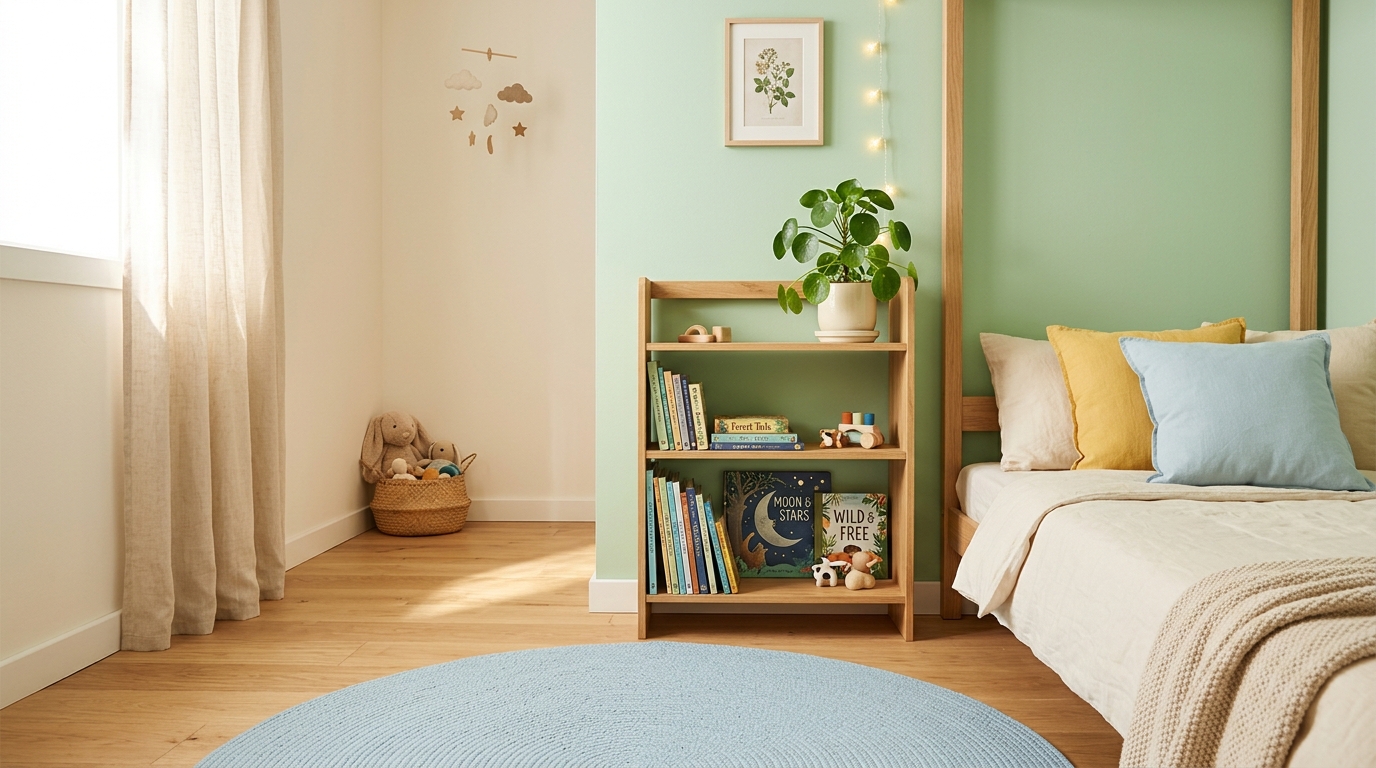
Color is silent energy — and for children, whose nervous systems are still calibrating, it matters more than most parents realize.
Best colors for children's rooms:
✅ Soft, Calming Base Colors
- Light green — grounding, calming, encourages focus and emotional balance
- Soft yellow — cheerful, supports positivity and confidence
- Light blue — calming, promotes deep sleep and emotional steadiness
- Cream / off-white — clean, open, restful base
- Soft peach or coral (in accents) — warm and comforting
✅ Playful Accent Colors
- Bright colors are fine as accents — cushions, wall art, a single accent wall
- Just avoid dark or heavy tones dominating
Colors to avoid as dominant shades:
❌ Bright Red
Overstimulates the nervous system. Kids with red-dominant rooms often show more restlessness, temper flare-ups, and difficulty settling. Red is fine as a small accent, not a wall color.
❌ Deep Black or Very Dark Purple
Lower mood, make the room feel heavy, and can subtly amplify anxiety in sensitive children.
❌ Hot Pink or Neon Colors
Overstimulating even when eyes are closed — the nervous system still registers the room's overall color palette.
❌ Busy Patterns Dominating Every Wall
Too much visual complexity keeps the mind active when it should rest.
A simple rule of thumb: if the room's dominant colors would keep an adult from sleeping well, they're keeping your child from sleeping well too. Kids are more sensitive, not less.
Rule #5: What to Include (And What to Remove) 📚
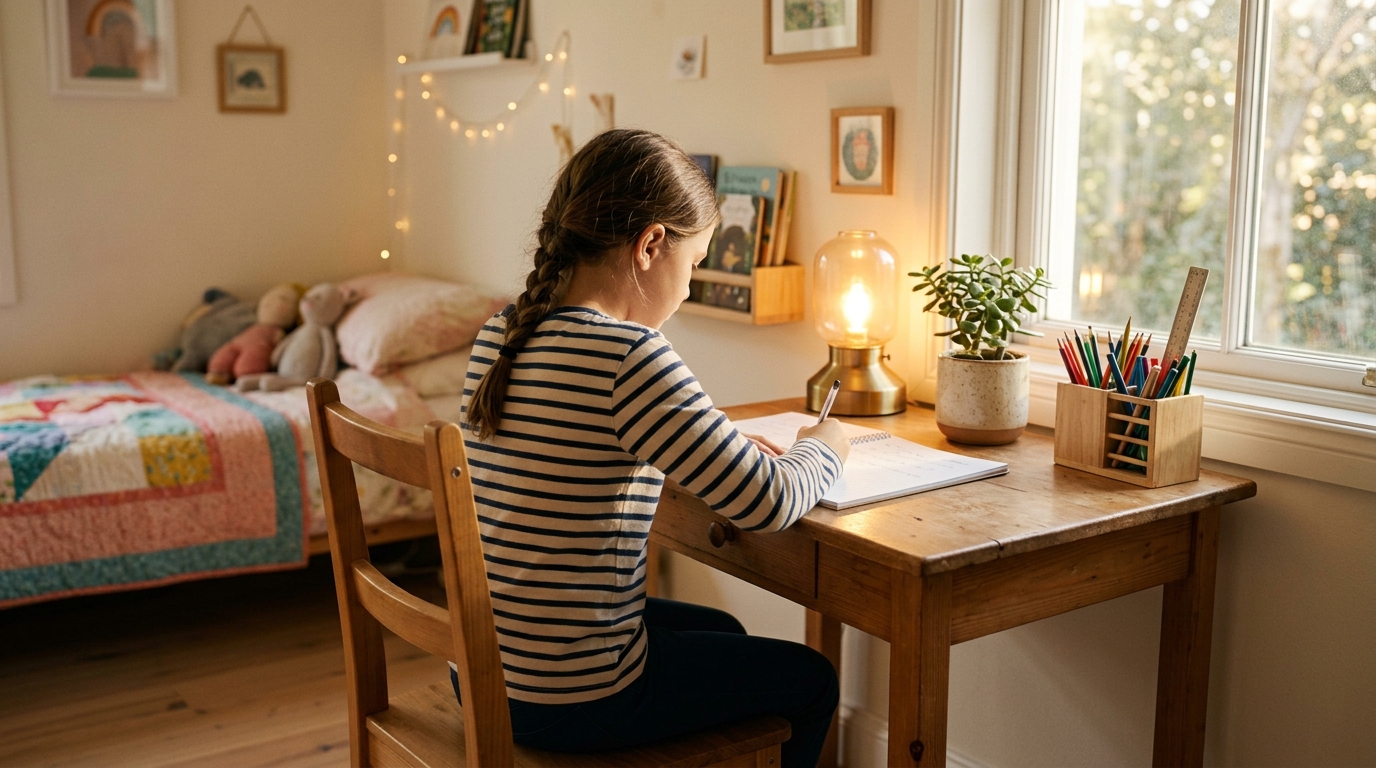
Beyond direction and color, the contents of your child's room shape their emerging personality every day.
✅ Include These:
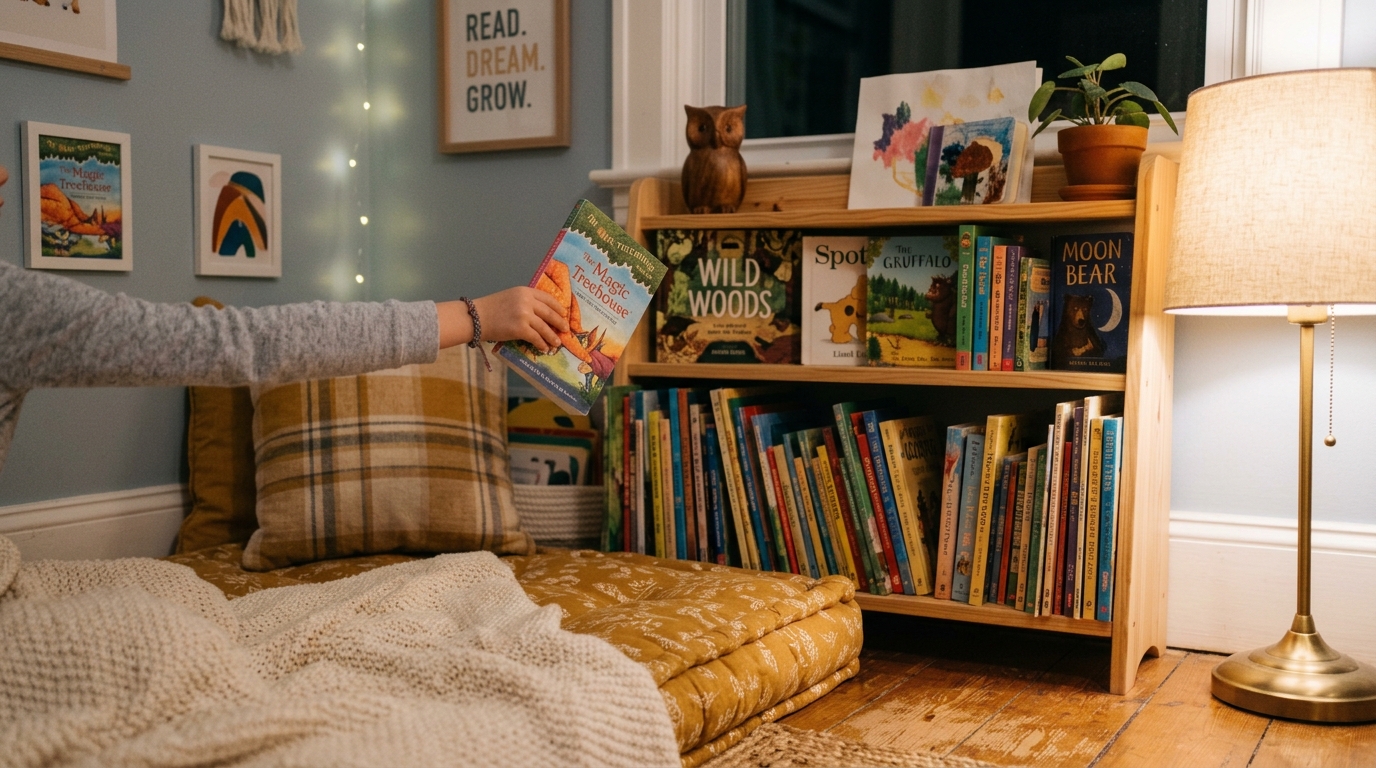
Books and reading space A small bookshelf or reading nook. Even for kids not yet reading independently — a visible book corner signals "this is a space where minds grow."
Educational or aspirational images Maps of the world, star charts, animal posters, images of nature. Something to spark curiosity.
A designated study area Even for young children, a small desk or table sends the message "this is where focus happens." Refer to our study table article for setup.
Warm lighting Warm yellow LED bulbs — never harsh white or blue-toned lighting. A small bedside lamp for reading. A gentle night light if your child needs one.
A small healthy plant A snake plant, money plant, or small fern — teaches responsibility, cleans the air, adds calming green energy.
A small pooja shelf or spiritual corner (optional) If your family practices any form of daily prayer or gratitude — a small dedicated corner in the child's room teaches them to have their own sacred space. We covered pooja placement in our pooja room article.
Cozy, natural fabrics Soft cotton bedding. Comfortable rugs. Textures that soothe.
❌ Remove or Limit These:
Electronics near the bed No TV facing the bed. Phones out of the room at night, or at least across the room in airplane mode. Gaming devices in a separate charging spot, not the bedside.
Aggressive or scary imagery Posters of violent characters, war themes, scary movie characters. Whatever imagery dominates the walls dominates their subconscious. Choose gentleness.
Excessive clutter and toys everywhere A child's nervous system reads clutter as chaos. A weekly cleanup — done with your child — teaches order while restoring calm.
Mirrors facing the bed As mentioned above — disrupts sleep and can create fear in younger children. If a wardrobe has mirrored doors, drape a soft cloth at night.
Broken toys or damaged furniture Fix, replace, or remove immediately. Vastu principle: broken things around growing children accumulate stagnant energy that affects development.
Too many stuffed animals on the bed Yes, it's cute. But 15 stuffed toys on a small bed reduces air circulation, holds dust, and creates visual clutter right in the child's sleep space. One or two favorites are perfect.
Special Considerations by Age 👶👧👦
Different developmental stages need slightly different room setups:
Ages 2-5 (Young Children)
- East-facing rooms work well for morning energy
- Head East while sleeping
- Very soft colors — pastels, cream, gentle yellows
- Simple room layout — too many toys/décor overwhelms
- A parent's item nearby for security (a piece of mom's fabric, a family photo)
Ages 6-10 (Growing Confidence)
- West-facing rooms are ideal
- Head East or South while sleeping
- Introduce a study corner — this is when focus habits form
- Books become important — a small bookshelf builds a lifelong reading habit
- Personalization — let them choose one accent color or item
Ages 10-14 (Pre-teens)
- North-West rooms support emerging independence
- Head South for deep sleep during growth spurts
- Dedicated study space is critical
- Privacy considerations — this is when their room becomes their sanctuary
- Limit electronics in the sleep space — this is the age when phones disrupt sleep most severely
The Sibling Room Question 👦👧
Many Indian families have siblings sharing a room. A few Vastu principles help:
If two siblings share:
- Beds on opposite walls rather than side-by-side — each child gets their own energy zone
- Both heads pointing East or South — never one pointing North
- A visual divider if possible (a bookshelf, a curtain, a small screen) — helps each child have "their space"
- Balanced colors — neither child's preferences dominating the room
- Equal storage — perceived fairness matters more than parents realize
When siblings fight constantly: Check the room's Vastu. Often, room-related issues are amplifying underlying sibling tension. We covered the deeper causes in our house fights article.
Sleep Hygiene: The Small Nightly Rituals 🌙
Beyond the physical room, the small rituals around bedtime shape a child's relationship with their space.
Simple bedtime Vastu practices for kids:
- A quick tidy before sleep — teaches order and calms the mind
- Warm bath before bed — cleanses accumulated day-energy
- Warm-toned lamp only in the hour before sleep (no bright overhead lights)
- A few minutes of quiet time — reading, cuddling, or gentle talk
- A brief gratitude moment — even simple: "What made you happy today?"
- Lights out completely dark — or only a very soft night light if needed
- Phone/tablet OUT of the room at night — non-negotiable for good sleep
These small practices, done consistently, become the child's foundation for lifelong healthy sleep.
A Quick Vastu Audit for Your Child's Room ✅
Take 15 minutes this weekend and check honestly:
- Is my child's room in the West, North-West, South-West, or East?
- Does my child sleep with head pointing East or South (NOT North)?
- Is the bed against a solid wall with room on both sides?
- Is there no mirror facing the bed?
- Are the room's dominant colors calming (not red, black, or neon)?
- Is the study area separate from the sleep area?
- Is there a small bookshelf or reading corner?
- Is the room decluttered weekly?
- Are electronics away from the bed at night?
- Is there a small plant or living element in the room?
- Is the lighting warm-toned (not harsh white)?
- Are there no scary or aggressive posters/images?
Each "yes" strengthens your child's foundation. Each "no" is a small opportunity — usually fixable in an afternoon.
🗺️ Find the Ideal Room Position for YOUR Child
Knowing the West or North-West is ideal is one thing. Knowing which specific room in YOUR home falls in each direction — and which one is best suited for your child's age and temperament — requires seeing your floor plan mapped properly.
We built a free tool where you can upload your floor plan and instantly see your home mapped according to proper Vastu directions — including the ideal placement for your child's bedroom, study area, and every important corner of their room.
👉 Upload your floor plan and find the best room for your child in 30 seconds
Just a photo or scan (PNG, JPG, JPEG). Sometimes the greatest gift you can give your child is being in the right room — not the biggest one.
A Note for Anxious Parents 💕
If you've read this article and realized your child's room has multiple Vastu issues — please don't spiral into guilt.
I want to say this gently: children are more resilient than we give them credit for. A less-than-ideal Vastu setup does not mean you've failed your child. It doesn't mean lasting damage has been done. Kids grow up beautifully in all kinds of environments, and love matters far more than any single room detail.
But if your child has been struggling — with sleep, focus, temperament, or something you can't quite name — and their room happens to have Vastu issues, addressing those issues can be a genuine, gentle help. Not a magic solution. A quiet support.
Fix what you can. Do it lovingly. Involve your child if they're old enough. Make it a small family project on a Saturday afternoon. Even the process of caring for their room with them is a form of parenting.
Your child will feel it. 🌸
Final Thoughts: Room, Child, Person 💫
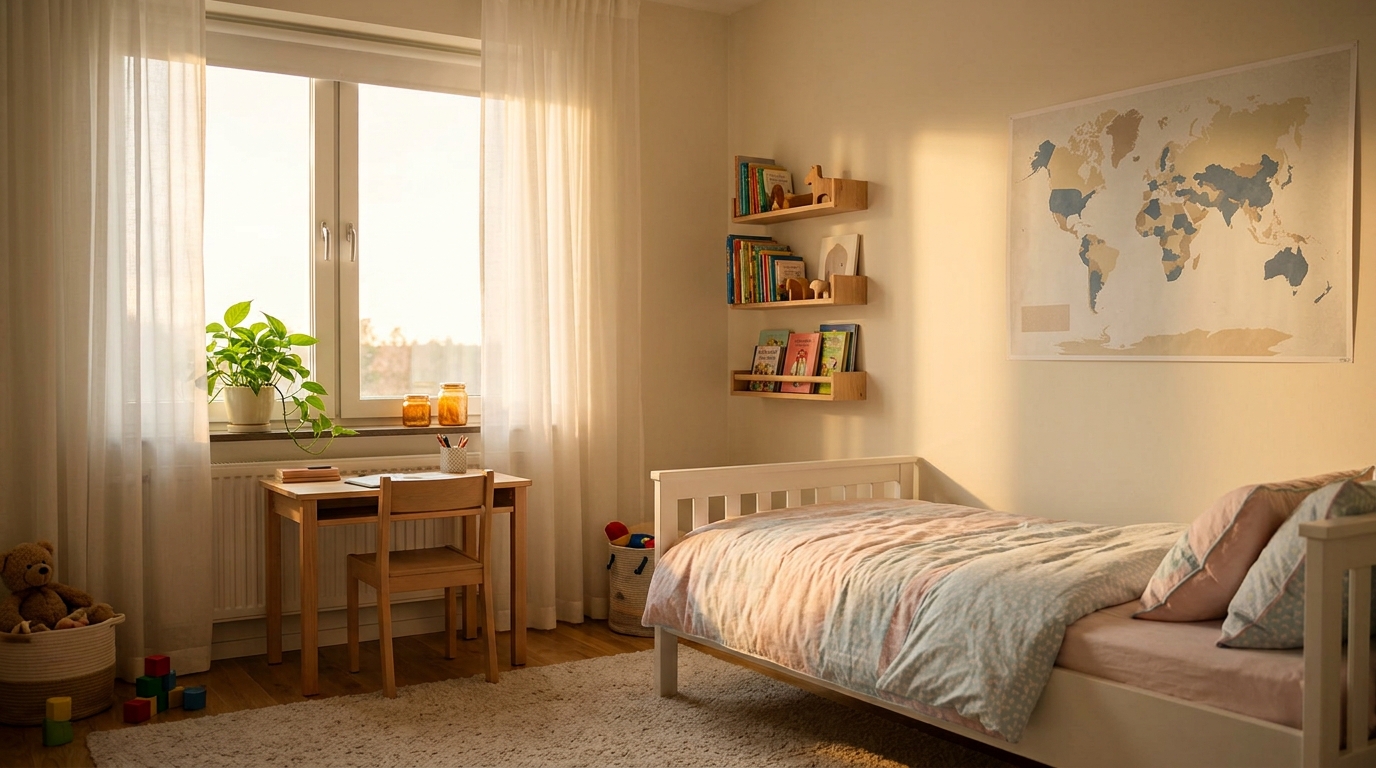
Here's something worth sitting with: your child spends more waking and sleeping hours in their room than almost any adult spends in almost any space in their life.
Ten hours of sleep. Two hours of homework. An hour of quiet play. Some hours of getting ready, changing clothes, listening to music, growing up. That's 14+ hours a day, every day, for years — happening inside four walls that you set up for them.
Those walls are quietly shaping the person your child is becoming. Their sleep patterns. Their focus habits. Their sense of safety. Their taste for order or chaos. Their reading life. Their relationship with themselves.
Vastu isn't about controlling every detail. It's about being intentional with the space our children live in — because we know it matters.
Take an afternoon this month. Walk into your child's room with fresh eyes. Rotate the bed if their head points North. Swap out the neon red pillow for a soft cream one. Move the study desk to face East. Take down the scary poster. Add a small plant. Fix the broken drawer. Wipe the walls clean.
Small changes. Big compounding effects.
Your child is a whole person becoming. Their room is the workshop. Set it up with love. 🌸📚
Do you have a child whose room needs a little Vastu love? Try just two or three of these fixes this weekend — and share this article with another parent who cares about how their child is growing up. Sometimes the greatest parenting gift is a well-set-up room. 🙏