

It is nine at night. Your laptop is open on one end of the dining table, a spreadsheet you promised by morning glowing on the screen. At the other end, your fifteen-year-old is bent over a maths textbook, pre-boards three weeks away. The pressure cooker whistles. Your phone buzzes with "Quick call?" from your manager, and your child sighs loudly enough for the whole building to hear.
Somewhere in the last few years, the Indian home quietly became an office, a coaching centre and an exam hall, all without adding a single room. The dining table, the bedroom corner and the sofa armrest now carry the weight of careers and board results.
Vastu has a lot to say about this. Not in the sense of "buy a new house," but in the far more useful sense of where to put the desk you already have, which way to turn the chair you already own and what to clear from the corner you already use. Small shifts, done right, can make the difference between reading the same page five times and actually finishing the chapter.
This guide covers both the home office and the study room: the best zones, the best facing directions, desk and chair rules, colours, light, clutter and the one change that costs nothing at all.
Why Your Desk Position Matters More Than Your Desk
You can spend ₹40,000 on an ergonomic chair and still feel scattered every afternoon. The furniture matters far less than where it sits.
The sceptic will say concentration is about discipline, sleep and phone habits, not compass directions. Partly true. But look at what Vastu actually asks of a workspace and you'll find a lot of common sense in traditional language.
Vastu says to sit with a solid wall behind you. Psychologists call this the "command position": with your back protected and the door in view, the nervous system relaxes and the mind stops scanning for interruptions. Vastu says to face North or East. Those are the directions that bring soft, even daylight into most Indian homes, without the harsh afternoon glare of the West. Vastu says to keep the North-East corner clean and light. Clutter in your line of sight is a proven drain on attention.
The tradition explains all of this through the flow of prana (life energy) and the qualities of each direction. You don't have to accept every part of that explanation to benefit from the advice. Try it for three weeks and judge by your own work.
The Best Zones for a Home Office
If you have the luxury of choosing a room, or even a corner, here is how the zones compare. (For the finer 16-zone picture, see our complete guide to the 16 sub-directions.)
North: The Zone of Opportunity and Wealth

North belongs to Kubera, the keeper of wealth. It governs new openings, career moves, client enquiries and money coming in. For anyone in sales, consulting, business development or freelancing, this is the strongest zone for a home office.
- Best for: client calls, pitching, job hunting, building a business.
- Keep it light, open and uncluttered. A North office stuffed with files and cartons blocks exactly the energy you want flowing.
East: The Zone of Connection and Fresh Starts
The rising sun's direction is linked to social connection, recognition and new beginnings. An East-facing workspace suits people whose work depends on relationships: teachers, HR professionals, doctors on teleconsultation, content creators.
- Morning light from East windows is a genuine productivity booster.
- Avoid heavy dark curtains kept shut all day.
West: The Zone of Gains
West governs gains, the fruits of effort and the profit you actually keep. It is a solid choice for steady, desk-bound work: accounts, coding, analysis, long-form writing.
- A good zone if you need to finish things rather than start them.
Zones to Avoid for Work
- South-East: The fire zone. Wonderful for the kitchen, but a workspace here can bring heated arguments on calls and burnout.
- East-South-East: The zone of churning. It is perfect for the washing machine and terrible for a desk; you may find yourself overthinking every email.
- South-South-West: The zone of disposal. Work done here tends to drain away, as do payments.
- The exact centre (Brahmasthan): Keep the heart of the home open. A desk in the middle of the living room rarely feels settled.
The Best Zones for a Study Room
Children and students need a different quality of energy from working adults. They need retention, patience and a calm mind, more than opportunity and deal-making.
West-South-West: The Zone of Education

In the 16-zone system, the West-South-West is the zone of learning and accumulated knowledge. If there is one place to set up a child's study desk, especially for exam preparation, it is here.
East and East-North-East: Light and a Happy Mind
East brings clarity and morning freshness. The East-North-East is the zone of joy and refreshment, ideal for younger children who need learning to feel light, not like punishment.
North-East: Wisdom, With Care
The North-East (Ishan) is the zone of clarity and higher learning. A study desk here can work beautifully for older students and researchers, but the corner must stay light. No heavy almirahs, no stacks of old notebooks, no dustbin under the desk. If your pooja room is already here, keep the study near it rather than in it.
Where Not to Study
- South-East: Restlessness and irritability.
- North-West: The zone of movement. Children who study here often get up every ten minutes. Fine for a guest room, not for board prep.
- Directly under a staircase or beam: Traditionally said to create mental pressure. Practically, it is also a dark, cramped spot.
Which Way Should You Face While Working or Studying?
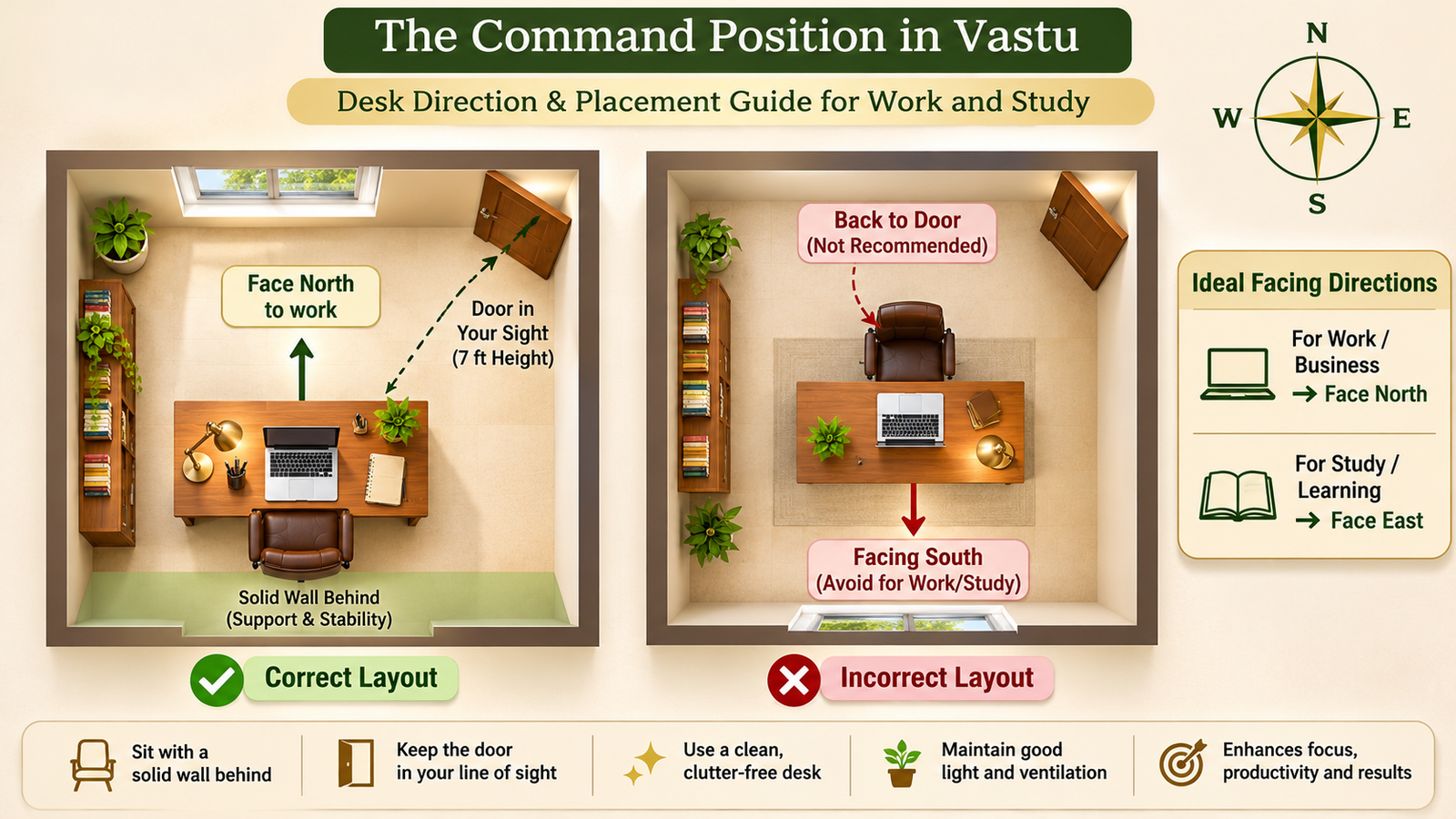
If you change only one thing after reading this article, change this.
For work and career: face North. North is the direction of opportunity. Professionals, business owners and anyone handling money traditionally sit facing North.
For study and learning: face East. East is the direction of knowledge and the rising sun. Students, teachers and anyone learning a new skill do best facing East. North-East is also excellent for focused study.
What to avoid:
- Facing South while working is traditionally linked to low motivation and dissatisfaction.
- Sitting with your back to the door. You will be startled every time someone walks in, and part of your mind never settles.
- Facing a toilet wall. If the bathroom shares a wall with your desk, turn the desk or shift it to another wall.
If the room layout forces a West-facing desk, don't panic. Keep a solid wall behind you, keep the desk clear and put a small plant or a picture of a sunrise where your eyes rest when you look up.
📋 Save This: The Home Office and Study Room Checklist
📲 Screenshot this and send it to the family WhatsApp group:
VASTU FOR YOUR DESK: 10 QUICK CHECKS
1. 🧭 Working? Face North. Studying? Face East.
2. 🧱 Solid wall behind your chair, not a window or door.
3. 🚪 You can see the door without turning around.
4. 📚 Best study zone: West-South-West. Best office zone: North.
5. 🪵 Rectangular desk, not cracked, not wobbly.
6. 💡 Desk lamp in the South-East corner of the desk.
7. 🧹 North-East corner of the desk and room kept clear.
8. 🪞 No mirror reflecting your books or laptop.
9. 🔌 Wires bundled, nothing broken on the desk.
10. 🛏️ Never study on the bed.
Desk, Chair and Layout: The Practical Rules
The Desk
- Shape: Rectangular or square. Irregular, curved or L-shaped desks with a cut corner are traditionally considered unsettled. If you love your L-shaped desk, keep it, but use the longer arm as your main working surface.
- Material: Wood is ideal. Glass tops can feel cold; a desk mat helps.
- Condition: No cracks, no wobble, no broken drawer. A broken desk mirrors a stuck project.
The Chair
- Choose a chair with a high, solid back. In Vastu, a supported back means a supported career.
- Avoid sitting on a stool or floor cushion for long hours if you can help it.
- Don't keep the chair directly under a ceiling beam.
Arranging the Desk Surface

Think of the desk itself as a small Vastu grid:
- North-East of the desk: Keep it lightest. A glass of water, a small crystal or a single fresh flower.
- South-East of the desk: The fire corner. Your lamp, laptop charger or monitor belongs here.
- South-West of the desk: Heavy reference books, files you need to keep.
- North of the desk: Your phone or a notepad for new ideas and opportunities.
Shelves and Storage
Heavy bookshelves and filing cabinets belong on the South or West walls of the room. Keep the North and East walls lighter, with open shelves or a soft-board for notes and timetables.
Colours, Light and Plants
Colours That Help You Focus
- Light green: Growth and calm; excellent for both offices and study rooms.
- Cream, off-white and pale yellow: Clarity and a sense of space. Pale yellow is traditionally linked to Guru (Jupiter), the planet of learning, which makes it a lovely choice for a child's room.
- Light blue: Calm communication, good for someone on calls all day.
- Avoid: Dark red, black and very bright orange on the walls you face. They are stimulating in the wrong way.
Light
Natural light from the North or East is the best desk lamp there is. Place the desk so that daylight falls from the side or front, never from directly behind you, which casts your shadow onto the page. After sunset, use warm white light rather than harsh tube lights, and add a dedicated desk lamp in the South-East of the desk.
Plants
One or two healthy plants make a workspace feel alive. A money plant in a glass bottle or pot in the North suits a home office; a small tulsi near the East window brightens a study room. Avoid thorny plants like cactus on or near the desk. Our Vastu plants guide explains which plants suit each direction.
Electronics, Wires and Clutter
Vastu treats electronics as fire energy, so they are happiest in the South-East portion of the room or desk.
- Router and printer: South-East of the room, off the desk if you can manage it.
- Wires: Bundle them. Tangled wires are traditionally linked to tangled thoughts and delayed work.
- Broken gadgets: The cracked old phone, the dead calculator. Repair them or let them go.
- Paper: Clear the desk at the end of every workday.
When There Is No Separate Room
Most Indian homes, especially in cities, don't have a spare room to call an office. That's fine. Vastu works at the scale of a room, a corner and even a desk.
The bedroom corner: If you must work in the bedroom, choose the West or North side of the room, never directly facing the bed. When the workday ends, cover the laptop or close it inside a drawer, so the bedroom remembers it is for rest.
The dining table: Sit on the side that lets you face North or East. Clear it completely before meals. A working dining table that never gets cleared slowly turns family meals into meetings.
The small flat: A wall-mounted folding desk on the West or North wall is a smart, Vastu-friendly solution. Older homes and modern apartments handle space differently, and our guide to traditional and modern architecture in Vastu explains how to adapt the principles to compact layouts.
Two people, one space: If a parent works and a child studies in the same room, give the North-facing seat to the earning adult and the East-facing seat to the student. Separate them with a bookshelf rather than a curtain, and agree on headphones.
The Most Common Home Office and Study Mistakes
Studying on the bed. The bed is for rest. Studying on it confuses the body; you either fall asleep over the textbook or lie awake thinking about it. Move to a desk, however small.
The desk facing a window with the back to the door. It looks lovely in photographs, but the open window in front scatters attention, and the door behind keeps you on edge. Flip it.
A mirror behind or beside the desk. Mirrors are said to double whatever they reflect, including stress and workload. Cover it during working hours or move it.
The dustbin in the North-East of the study. A surprisingly common one, because that is where the room door often opens. Shift the bin to the South-West side of the room, ideally the South-South-West.
The ₹0 Fix: Turn Your Chair

You don't need a new room, new furniture or a carpenter. You need a phone compass and ten minutes.
Turn the desk so that you face North if you work, or East if you study. Push your chair back against a solid wall, and clear everything from the North-East corner of the desk except a glass of water.
That's it. Families who try this often say the difference shows within a week: the child stops wandering to the kitchen every fifteen minutes, the working parent finishes the report before dinner instead of after. With pre-board exams in December and January, and appraisal season not far behind, this is the right month to try it.
Common Questions
My child's room only allows a South-facing desk. What now? Keep a solid wall behind your child, place a picture of Goddess Saraswati or a sunrise on the wall in front, use a pale yellow or light green desk mat and make sure the room's North-East is completely clear. Small balancing steps go a long way.
Can I keep the home office in the pooja room? It is better not to. Keep the pooja space for prayer. You can, however, place the study desk near the pooja room in the North-East so that the calm carries over.
📐 Do You Know Which Zone Your Desk Is Sitting In?
Most of us chose our work corner because that's where the plug point was. Very few of us know whether that corner is the North that invites opportunity or the East-South-East that keeps us churning.
We built a free tool where you can upload your floor plan and instantly see it mapped according to proper Vastu directions — so you can find the exact zone for a focused home office and a calm study corner before you move a single chair.
👉 Upload your floor plan and find your best desk zone in 30 seconds
Just a photo or scan (PNG, JPG, JPEG). The plug point can follow you.
Final Thoughts
The Indian home has always made room for one more thing: one more guest at the table, one more cousin on the mattress, one more festival on the calendar. Now it is making room for careers and exam results too. Vastu doesn't ask you to build a new office. It asks you to give your work and your children's learning a place that supports them.
Face North when you earn. Face East when you learn. Keep a wall at your back and the North-East clear in front of you. Do that much, and the rest of the advice is fine-tuning.
The best desk in the house isn't the most expensive one. It's the one facing the right way.
🧭 Shubham Bhavatu. May every hour at your desk move you forward. 🙏