

Your aunt has come over to help with the Diwali cleaning. You are both on your knees, pulling old newspapers out from under the sofa, when she stops, looks around the living room and says, "This corner is North-East, na? Then why is the dustbin here?"
You move the dustbin. It goes to the next corner. She frowns again. "That's East. Also not good." Five minutes later the poor dustbin is standing in the middle of the room and neither of you knows where it belongs.
Most of us grew up knowing Vastu in four or eight directions. North for money, North-East for prayer, South-East for the kitchen, South-West for the master bedroom. It works, roughly. But a home isn't divided into eight neat slices. Between North and North-East there is a zone that behaves differently from both. Between South and South-West there is a strip that the old texts treated very carefully. Vastu, read closely, works with 16 sub-directions, and once you know them, the dustbin finally has a home.
This guide walks you through all 16 zones: what each one governs, what belongs there, what doesn't, and the simple fixes when something is in the wrong place.
Why 16 Directions and Not 8?
A compass has 360 degrees. The four cardinal directions (North, East, South, West) and the four corners (North-East, South-East, South-West, North-West) divide it into eight slices of 45 degrees each. That is the Vastu most families know.
But traditional Vastu thinking, built on the Vastu Purusha Mandala (the sacred grid that maps a plot onto a cosmic body), always recognised that energy shifts gradually as you move around the circle. North-East is not the same at its northern edge as at its eastern edge. Splitting each 45-degree slice in two gives you 16 zones of 22.5 degrees each, and that finer resolution explains a lot of things the 8-direction view cannot.
Here's a simple example. Two families both have their toilet "in the South-West." One family feels perfectly settled; the other struggles with constant arguments and money leaks. When you measure precisely, the first toilet sits in the South-South-West, a zone traditionally associated with disposal and letting go. The second sits squarely in the South-West, the zone of stability and relationships. Same broad direction, very different result.
The sceptic in you might call this splitting hairs. Fair enough. But knowing a shop is "in South Mumbai" is useful; knowing its lane saves you an hour. The 16 zones are the lane-level map of your home.
How to Find the 16 Zones in Your Home

Before you can use any of this, you need an accurate map. Here is how to make one:
- Get a floor plan. The builder's brochure plan or a careful sketch on graph paper works.
- Find the centre. For a rectangular home, draw two diagonals; where they cross is the centre, the Brahmasthan. For an L-shaped or irregular home, complete the rectangle mentally or use the centre of the largest regular block.
- Take a compass reading. Stand at the centre of the home, away from fridges, metal almirahs and electrical panels, and note where magnetic North falls. A phone compass is fine if you calibrate it first and take two or three readings.
- Draw 16 lines. From the centre, mark North, then draw a line every 22.5 degrees around the circle. Label each slice.
You now have 16 wedges radiating from the centre of your home, like slices of a pizza. Every room, cupboard, toilet and doorway falls into one of them.
The 16 Vastu Zones Explained
Let's go around the compass clockwise, starting from North. For each zone you'll find its traditional association, what suits it and what to avoid.
1. North (N): The Zone of Opportunity and Wealth
North belongs to Kubera, the keeper of wealth. This zone governs new opportunities, career openings and the flow of money into your life.
- Best for: Living room, home office, an open space, a water feature or aquarium, light green or blue tones.
- Avoid: Toilets, heavy storage, shoe racks, dustbins, red colour.
2. North-North-East (NNE): The Zone of Health and Immunity
This narrow zone is linked to health, healing and the body's ability to recover.
- Best for: Drinking water storage, a medicine cabinet, a light open space, a few healthy plants.
- Avoid: Toilets, kitchens, heavy furniture, junk.
- Quick fix: Keep your drinking water matka or filter here. It is a small, satisfying change.
3. North-East (NE): The Zone of Clarity and the Divine
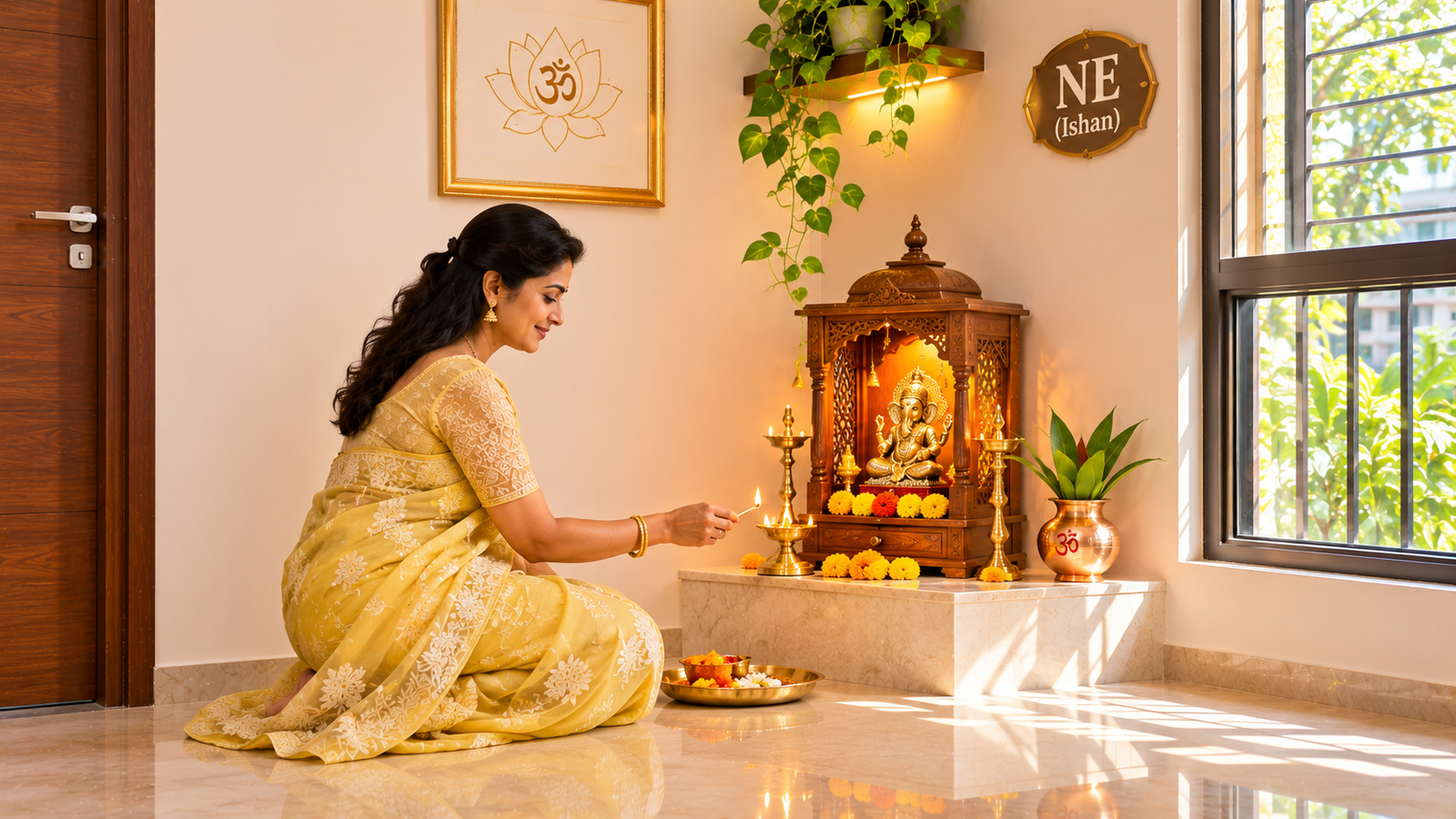
Ishan, the sacred corner. This is the zone of mental clarity, intuition and spiritual connection. It is the most sensitive zone in the home.
- Best for: Pooja room or altar, meditation corner, a window that catches the morning light, an empty and clean space.
- Avoid: Toilets, kitchens, staircases, heavy storage, dustbins (yes, your aunt was right).
- Quick fix: Clear it completely. Light a diya here in the evening.
4. East-North-East (ENE): The Zone of Joy and Refreshment
This zone governs recreation, play and the lightness that makes a home feel happy.
- Best for: Family lounge, children's play area, a reading nook, a music corner.
- Avoid: Toilets, heavy almirahs, a pile of unfinished paperwork.
5. East (E): The Zone of Social Connection
The rising sun's direction, linked to Indra and to your social standing, friendships and relationships with the wider community.
- Best for: Main entrance, living room, large windows, a family photo wall.
- Avoid: Tall blocking walls, toilets, stores, heavy dark curtains kept shut all day.
6. East-South-East (ESE): The Zone of Churning and Analysis
This is a restless zone, associated with churning, overthinking and anxiety. But churning isn't always bad. It is also the energy of the mixer-grinder and the washing machine.
- Best for: Washing machine, mixer, a utility area, an ironing space.
- Avoid: Bedrooms (sleeping here can bring restless nights), study desks, the pooja room.
- Quick fix: If someone in the family can't stop worrying, check whether they sleep in this zone.
7. South-East (SE): The Zone of Fire and Cash Flow

Agni's zone. Fire here means transformation, energy and the steady flow of cash through the household.
- Best for: Kitchen and cooking stove, electrical panels, inverter, a red or orange accent.
- Avoid: Water tanks, sinks directly next to the stove, toilets, blue colour schemes.
- Quick fix: If the kitchen can't be here, place a red lamp or a small electrical appliance in this zone.
8. South-South-East (SSE): The Zone of Strength and Confidence
This zone fuels courage, willpower and self-confidence.
- Best for: Bedroom for a young adult, a gym or exercise corner, an electrical appliance.
- Avoid: Toilets, water bodies, a cluttered store room.
9. South (S): The Zone of Rest and Recognition
South is associated with Yama, and in Vastu it governs relaxation, deep rest and your reputation in the world. Heaviness here is good.
- Best for: Bedrooms, heavy furniture, solid walls, a framed award or certificate.
- Avoid: Main entrance in the middle of South (it needs care), large openings, water features.
- Quick fix: Sleep with your head pointing South for the deepest rest; never with your head to the North.
10. South-South-West (SSW): The Zone of Disposal
This is the zone of letting go: expenditure, waste and getting rid of what you don't need. It is the one place in the home where a dustbin truly belongs.
- Best for: Toilets, the dustbin, a store for old items awaiting disposal.
- Avoid: Your locker, cash box or anything valuable (money kept here tends to drain away), the main entrance.
- Quick fix: Your aunt's dustbin goes here. Problem solved.
11. South-West (SW): The Zone of Stability and Relationships
The Nairutya corner, home of the householder. It governs permanence, family bonds, marriage and the skills you have built over a lifetime.
- Best for: Master bedroom, heavy wardrobes, family heirlooms, a framed photograph of the couple or elders.
- Avoid: Toilets, the main entrance, underground water tanks, cut corners or open balconies left bare.
12. West-South-West (WSW): The Zone of Education and Savings

This zone governs learning, knowledge and accumulated savings. It is excellent for children who need to concentrate.
- Best for: Study room, a bookshelf, a desk for exam preparation, a long-term savings file.
- Avoid: Toilets, a television that distracts, clutter.
13. West (W): The Zone of Gains and Profit
Varuna's direction. West governs gains, the fruits of your effort and the profit you actually keep from your work.
- Best for: Dining room, children's bedroom, a store for valuable items, overhead water tanks.
- Avoid: A broken or cluttered West wall, toilets right in the middle of West.
- Quick fix: Display something you're proud of earning: an award, a trophy, a framed first salary slip.
14. West-North-West (WNW): The Zone of Release and Detox
This zone governs letting go of emotional heaviness: grief, old grudges, low moods.
- Best for: Toilets, a store room, a place to keep things you plan to donate.
- Avoid: A bedroom (it can bring low moods), the pooja room, a study desk.
15. North-West (NW): The Zone of Support and Help
Vayu, the wind. This zone governs the support you receive from others: banks, colleagues, friends, domestic help, even the neighbour who keeps your spare key.
- Best for: Guest bedroom, a garage, storage for finished goods, a wind chime.
- Avoid: Master bedroom for the head of the family (they may feel unsettled), heavy clutter.
16. North-North-West (NNW): The Zone of Attraction and Romance
The final zone governs attraction, intimacy and the pull between people. For couples, it is a quietly powerful zone.
- Best for: Bedroom for a married couple, soft lighting, a pair of objects (two cushions, two candles).
- Avoid: Toilets, broken furniture, single or solitary decor items.
- Quick fix: Newly married? This is a lovely zone for your bedroom. Our newlyweds' first home Vastu guide has more ideas.
📋 Save This: The 16-Zone Quick Reference
📲 Screenshot this and send it to the family WhatsApp group:
THE 16 VASTU ZONES AT A GLANCE
1. 🧭 N — Wealth and opportunity: living room, water
2. 💧 NNE — Health: drinking water, medicines
3. 🪔 NE — Clarity: pooja, meditation, keep empty
4. 🎈 ENE — Joy: play area, family lounge
5. 🌅 E — Social connection: entrance, windows
6. 🌀 ESE — Churning: washing machine, mixer
7. 🔥 SE — Fire and cash flow: kitchen
8. 💪 SSE — Strength: gym, young adult's room
9. 😴 S — Rest and fame: bedrooms
10. 🗑️ SSW — Disposal: toilet, dustbin
11. 🏔️ SW — Stability: master bedroom
12. 📚 WSW — Education and savings: study
13. 🏆 W — Gains: dining, children's room
14. 🍃 WNW — Release: toilet, donation box
15. 🤝 NW — Support: guest room
16. 💞 NNW — Attraction: couple's bedroom
The Most Common 16-Zone Mistakes
After you map your home, a few problems show up again and again.
The dustbin in the North-East. It's often there because that's where the kitchen door opens. Move it to the South-South-West or West-North-West, even if that means a few extra steps.
The locker in the South-South-West. Heaviness belongs in the South-West, but if the locker slips into the disposal zone, money tends to slip out too. Shift it into the South-West proper. Our borrowed objects Vastu guide explains why money energy is so sensitive to placement.
The study desk in the East-South-East. A child who studies in the churning zone often reads the same page five times. Move the desk to the West-South-West or the East.
The toilet in the North-North-East. A common modern dosha. Keep the door closed, the toilet spotless and well ventilated, and place a bowl of sea salt inside, replaced weekly.
The ₹0 Fix: Move One Thing to the Right Zone

You don't need to rebuild anything to start. You need a compass and five minutes.
Find your South-South-West zone and move your dustbin there. Then find your North-East and take everything out of it that doesn't belong.
That's it. One object goes into the zone made for disposal, and the zone made for clarity is cleared. With Diwali just days away and most of us already deep-cleaning, this is the perfect week to do it. If you're planning the festival setup, our complete Diwali Vastu guide tells you exactly where the diyas, rangoli and Lakshmi puja belong.
Families who try this often say the house simply "feels lighter." That is good Vastu and good housekeeping at the same time.
What If a Room Is in the "Wrong" Zone?
Almost no home is perfect. You will find a toilet somewhere awkward or a bedroom straddling two zones. That's normal. Vastu is about balance, not perfection.
Use the zone's element. Each zone is linked to one of the five elements (Panchabhuta). North and North-East favour water, the South-East favours fire, the South-West favours earth, the North-West favours air, and the centre favours space. Strengthen the element of the zone you're struggling with: a bowl of water in the North, a red lamp in the South-East, a heavy stone or brass object in the South-West.
Use colour. Blues and greens in the North, earthy yellows in the South-West, reds in the South-East, white and grey in the West. It's an easy fix for renters too.
Use plants wisely. Our Vastu plants guide lists which plant suits which direction.
Don't break walls first. Rearrangement, decluttering, lighting and colour solve most problems.
Common Questions
Is the 16-zone system a modern invention? The idea of dividing a plot into fine zones is rooted in the traditional Vastu Purusha Mandala, which already split the plot into 64 or 81 squares ruled by different deities. The 16-zone method is a practical way of reading that same principle on a compass. My flat has an irregular shape. Can I still use 16 zones? Yes. Find the centre of the largest regular block, draw your 16 lines from there, and treat any extension or cut as a zone that is enlarged or missing.
📐 Do You Know Which of the 16 Zones Your Dustbin Is In?
Most of us can guess where North is. Very few of us can point to the exact 22.5-degree slice where the toilet, the locker and the study desk actually sit.
We built a free tool where you can upload your floor plan and instantly see it mapped according to proper Vastu directions, so you can see all 16 zones laid over your rooms and spot what is sitting in the wrong place.
👉 Upload your floor plan and see all 16 Vastu zones in 30 seconds
Just a photo or scan (PNG, JPG, JPEG). Your aunt will finally stop moving the dustbin.
Final Thoughts
Eight directions tell you the neighbourhood. Sixteen tell you the street. Once you can see your home as 16 zones, Vastu stops being a list of vague rules and becomes something practical: this corner for water, that one for rest, this strip for letting go.
You don't need to get every zone right. Start with three: clear the North-East, give the South-West its weight, and send the dustbin to the South-South-West. Then add one more change each month and notice how the house feels.
Every corner of your home has a job. The trick is letting each one do it.
🧭 Shubham Bhavatu. May every corner of your home work in your favour. 🙏