
There's a specific moment that happens in most Indian families.
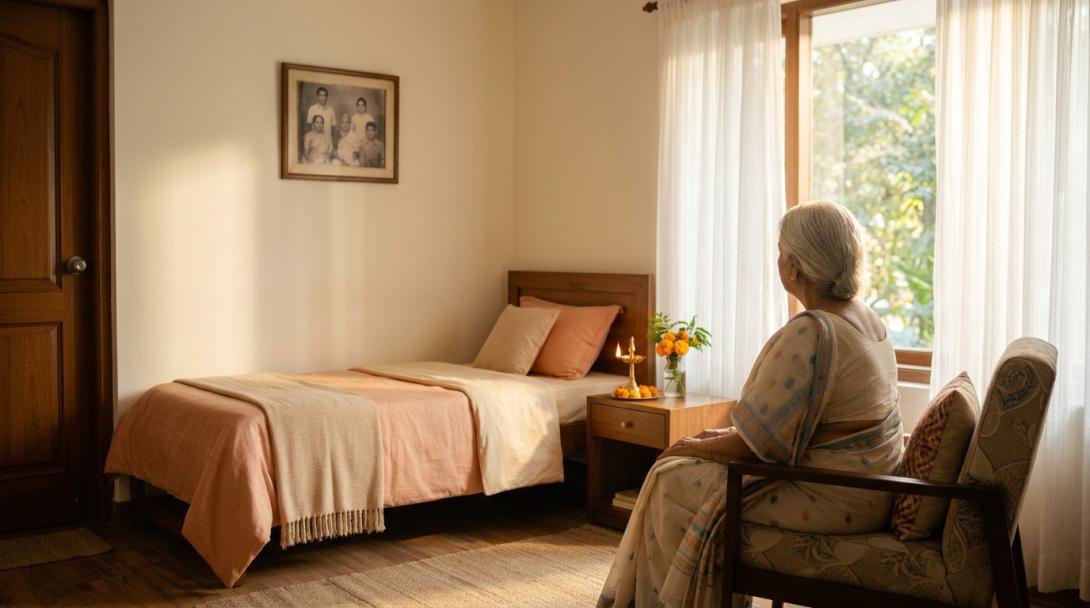
It might come when your parents finally move in with you. It might come after your father's surgery, when the second bedroom quietly becomes their permanent space. It might come as your mother, now widowed, sits in her small corner of the family home, watching the great-grandchildren play with a soft smile that doesn't quite reach her eyes.
Somewhere in there — usually without discussion, often without much thought — the room your elders live in gets set up.
The bed gets placed against whichever wall was available. The wardrobe goes where the previous furniture had been. The TV goes on the side no one else uses. The window curtains might not have been washed in years. The bathroom tiles have that faded look. The overhead light is that harsh white LED that no one has bothered to change.
And your parent — this person who fed you, raised you, sacrificed for you, taught you to walk and read and pray — quietly lives in it. Never complaining. Never asking. Never making it about them.
Here's a truth that quietly haunts many adult children when they finally think about it: we obsess over our children's rooms and our own bedrooms, but we often give our elderly parents' spaces the least Vastu attention of anyone in the household.
We do this without meaning to. Elders don't ask. They adapt. They tell you "it's fine, beta." And so we forget that the room they spend the majority of their remaining life in matters — perhaps more than any other room in the home.
Vastu Shastra has always understood something deep about elder care. When our parents are in their later years, the space around them shapes not just their comfort but their dignity, their rest, their peace, their gentle transition through the final chapter of life. Getting this room right isn't just Vastu practice. It's a small, essential act of gratitude.
This guide is written for adult children — those of you who love your parents deeply and want to do this well. Whether they've just moved in with you, or have been living in a room that hasn't been touched in years, this article will help you set up their space with the care they've always deserved.
Why Elder Rooms Matter More Than We Realize
Our elders' relationship with their room is different from ours in fundamental ways.
They spend more time there. As mobility decreases, as social circles shrink, as energy for outside activities fades — their room becomes their primary world. Meals are sometimes taken here. Prayers happen here. Old friends visit here. Books are read here. Life increasingly happens within these four walls.
Their nervous systems are more sensitive. Advanced age brings physiological changes that make sleep more fragile, temperature regulation harder, and environmental disturbances more disruptive. What we would barely notice, they feel deeply.
They can't easily articulate what's wrong. Younger adults complain, adjust, rearrange. Elders often accept whatever they're given, especially if they don't want to be "trouble" for their adult children. This means Vastu problems compound silently in their rooms — often for years.
Their emotional landscape is different. Later life often brings reflection, sometimes grief for lost peers, sometimes concerns about mortality. The room they live in shapes this inner landscape either gently — or harshly.
Their bodies need specific support. Fall risks, medication routines, mobility aids, health monitoring — the room needs to serve real physical needs that we don't have to think about yet.
Modern gerontology (the study of aging) confirms what Vastu has always known: environmental factors dramatically affect elderly well-being. Air quality, natural light, temperature stability, spatial familiarity, sound levels, and sense of dignity in their space all shape both physical health and emotional peace during aging.
Vastu just describes these principles in a different vocabulary — and adds a beautiful additional layer: the sacred honoring of elderhood itself.
Rule #1: The Ideal Room Position — South-West or South 🧭
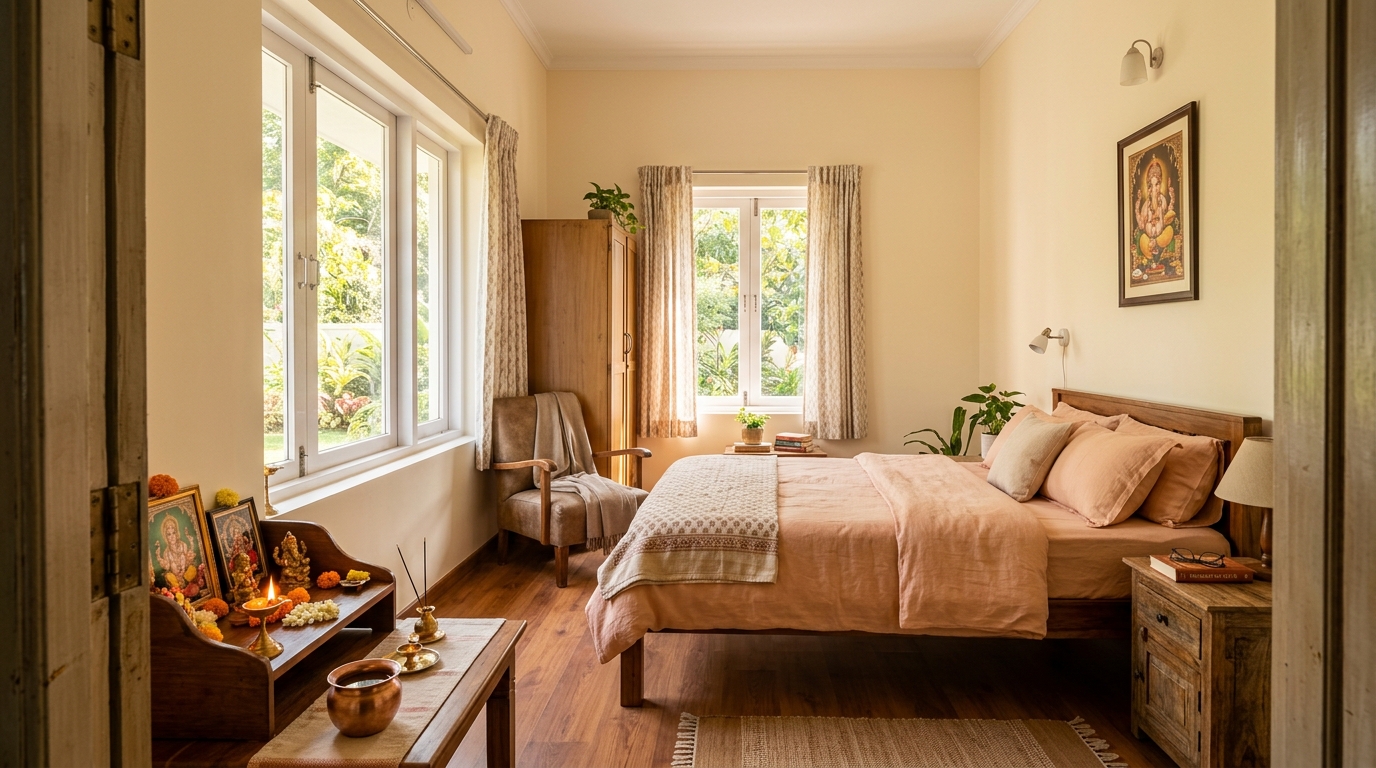
The most important Vastu principle for elder rooms:
Best directions for a senior citizen's room:
✅ South-West — The Ideal Zone
The South-West is the most grounded, protected, stable zone of any home. It's associated with the earth element — steadiness, groundedness, permanence. This is where the head of the household traditionally sleeps in Vastu — and for elder parents, especially the eldest members of the family, this zone offers deep energetic support.
For an aging parent, the South-West room provides:
- Deep, restful sleep
- Sense of protection and stability
- Grounded energy for a body that increasingly needs it
- Traditional recognition of the elder's position of respect
✅ West — Also Excellent
The West is stable, comforting, and workable. Good for grandparents who might not need the full weight of the South-West.
✅ South — Acceptable
The South is a grounding direction, workable for elders.
Directions to avoid for elder rooms:
❌ North-East (Ishan Kona)
The sacred zone — too energetically active for restful sleep, especially for an aging body. Better suited for pooja space.
❌ South-East (Fire Zone)
Fuels restlessness, irritation, and short tempers. Elders in South-East rooms often become uncharacteristically anxious or agitated.
❌ North-West
The wind zone — creates a "want to move" energy that unsettles the deep rest elders need.
❌ Center of the Home
Should stay open. Never turn the Brahmasthan into a bedroom.
Practical reality: In many homes, elder rooms end up wherever there's a spare room. If it's the South-West, wonderful. If not, apply extra remedies (heavier grounding elements, calming colors, extra lighting attention) to compensate.
A gentle suggestion: If you have multiple children living at home and one bedroom is clearly the South-West — consider giving that room to your parents rather than to a teenager. The teenager will adapt. Your parent will feel the difference profoundly.
Rule #2: The Bed and Sleep Direction — Head Towards South 🛏️
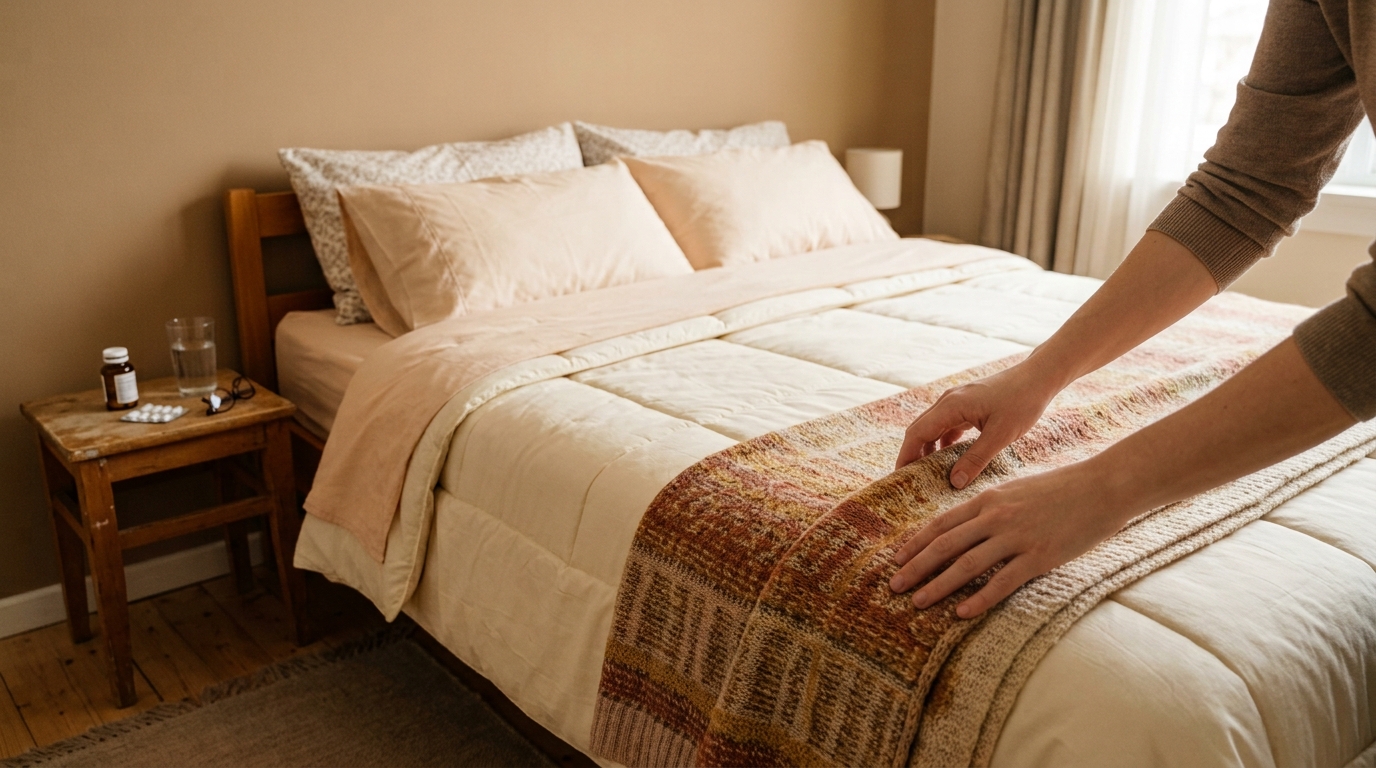
For elderly parents specifically, sleep direction becomes even more consequential.
The best sleep direction for seniors:
- ✅ Head pointing South — for the deepest, most restorative sleep
- ✅ Head pointing East — acceptable, especially for early risers who enjoy morning light
Directions to avoid:
- ❌ Head pointing North — disrupts sleep for all ages but especially for elders whose sleep is already fragile
- ❌ Head pointing West — less ideal though acceptable
Bed placement principles:
- Solid wall behind the headboard — protective and grounding
- Bed accessible from both sides if the parent needs help getting in and out
- Never under a window — exposure to nighttime disturbance, drafts, and light
- Never under a beam or sloped ceiling — creates pressure that older bodies feel more sharply
- Adequate space on at least one side for a bedside table with essentials (water, medications, phone)
- Bed height that suits their mobility — not so low they struggle to rise, not so high their feet don't touch the floor when seated
- A soft, well-supportive mattress — not too firm, not too soft, absolutely not old and worn out
We've written about sleep direction in general terms in our sleeping direction article and our wake up tired article — but for elders, these principles are non-negotiable.
A quiet request: if your parent has been sleeping with their head pointing North for years without complaint, please don't assume "it must be fine." Rotate the bed. Watch what happens over 1-2 weeks. They may be sleeping better than they have in years without realizing what changed.
Rule #3: The Bathroom — Accessibility Is Sacred 🚿
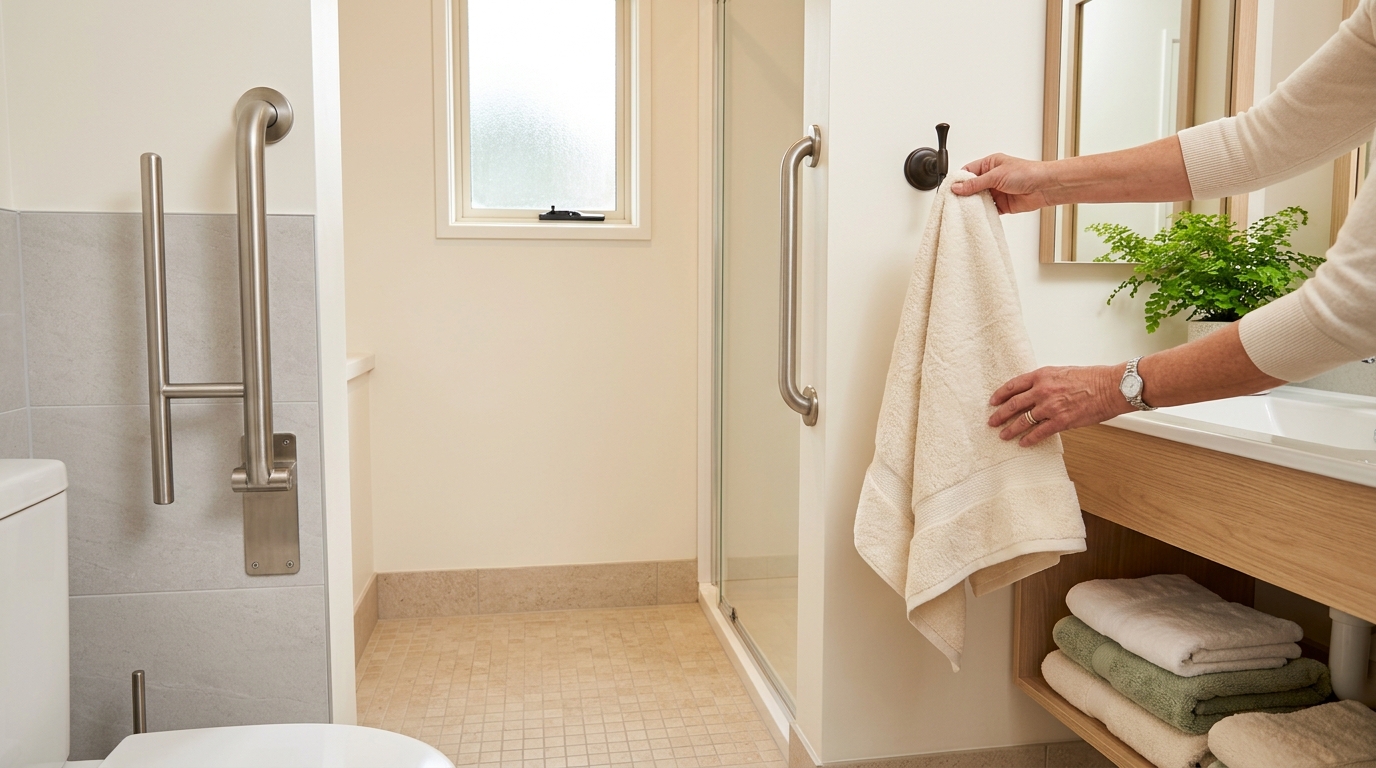
For elder rooms, the attached bathroom (or the bathroom your parent primarily uses) matters enormously — both for Vastu reasons and for basic dignity and safety.
Vastu principles for the elder bathroom:
- Position: ideally North-West or West (per our bathroom Vastu article)
- Door doesn't face the bed
- Kept scrupulously clean
- Never left in disrepair
Practical accessibility that overlaps with Vastu-aligned dignity:
- Non-slip flooring — a fall for an elderly person can be life-changing
- Grab bars near the toilet and in the shower area — essential for safety
- A shower chair or bath seat if standing showers are difficult
- Adequate warm lighting — never dim
- A raised toilet seat if arthritis makes low seats painful
- A night light so they don't fumble in the dark for nighttime trips
- Kept warm — cold bathrooms are physically harder on aged bodies
- Any leaks or damage fixed immediately — never say "we'll fix it later"
A gentle observation: the state of the bathroom your parent uses often reveals — more clearly than any words — how much attention the family is actually giving to their care. A bathroom with a broken tap, chipped tiles, faded curtains, and dim lighting communicates something to a parent that they may never say out loud but absolutely feel.
Make their bathroom beautiful. Make it safe. Make it dignified. Consider it one of the most important acts of Vastu practice you can do.
Rule #4: Natural Light and Ventilation 🌅
Elderly bodies respond powerfully to natural light and fresh air — often more than younger bodies do.
Why natural light matters especially for seniors:
- Circadian rhythm regulation — becomes more fragile with age; morning light exposure is one of the most powerful stabilizers
- Vitamin D — deficiencies are common in elders and can be partially addressed through natural light exposure
- Mood support — seasonal affective symptoms often intensify with age
- Reduced fall risk — well-lit rooms mean fewer accidents
- Better appetite — light exposure affects hunger hormones
Vastu-aligned lighting principles:
- East or North-East facing windows — morning light enters and consecrates the room
- Sheer curtains during daytime — let light in, maintain privacy
- Warm-toned artificial lighting — never harsh white or blue-toned LED
- Multiple light sources — overhead light, bedside lamp, reading light — rather than one harsh overhead
- Adequate lighting for reading — a properly-placed reading lamp is a beautiful gift for an elder who reads
- Soft night lighting — a small warm-toned night light for the pathway to the bathroom
Ventilation principles:
- Ensure cross-ventilation is possible (windows on opposite walls if possible)
- Open windows for at least 20 minutes daily
- Avoid heavy, permanently-closed AC-only rooms — bodies of any age but especially aged bodies need fresh air
- No dampness, mold, or stale smells — these disproportionately affect senior respiratory health
Rule #5: The Small Pooja Corner in Their Room 🪔
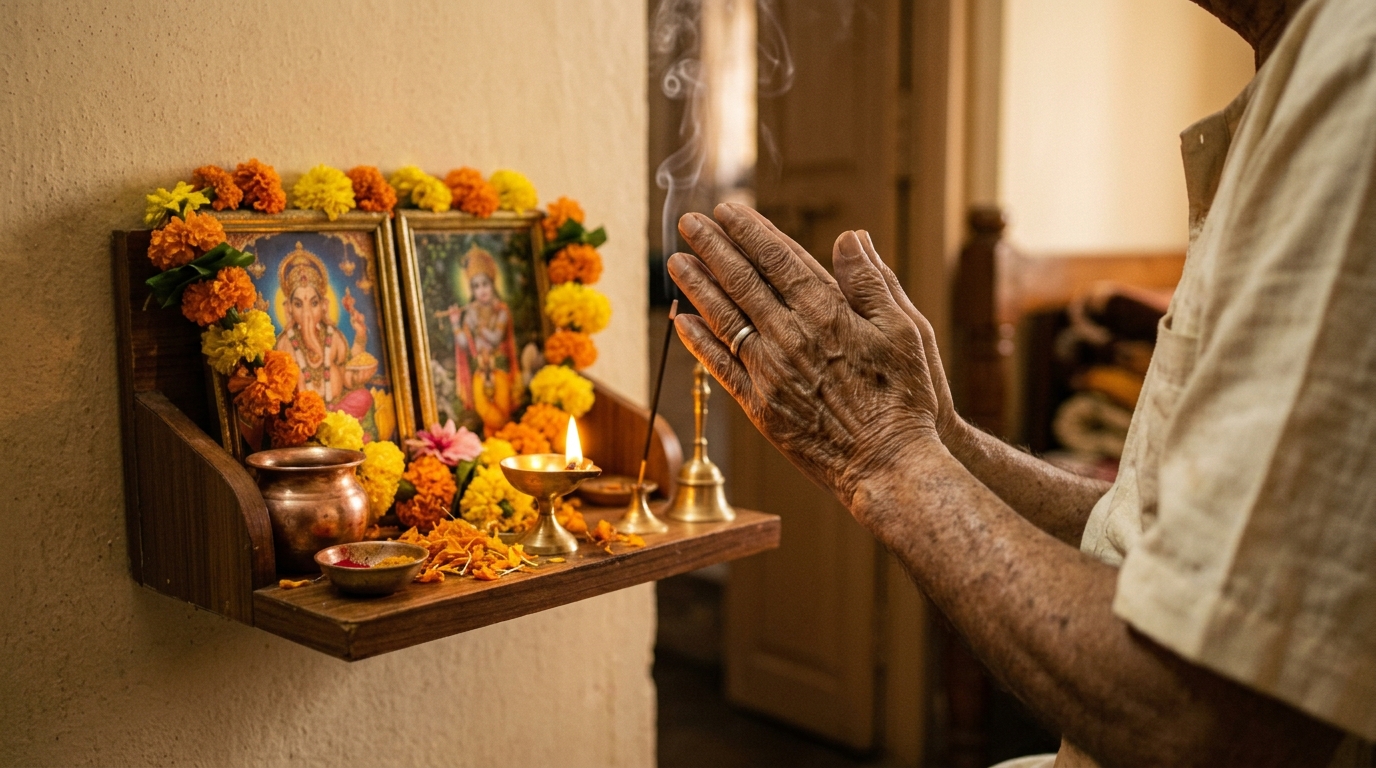
Many Indian elders have deepened their spiritual practice with age. Setting up a small sacred corner in their room is one of the most beautiful Vastu practices you can do for them.
The principles are the same as our pooja room article:
- North-East corner of the room for the small pooja shelf
- Idols facing East or North (so your parent faces East or North while praying)
- At a height comfortable for their reach — not too high, not too low
- Adequate lighting for their (likely weakening) eyes
- A comfortable seat or cushion in front of it — many elders can no longer sit on the floor for extended prayer
- Fresh flowers changed regularly — a small daily beauty
- A small brass bell within reach
- Their preferred images and books — this is their sacred space, not yours
A gentle suggestion: if your parent doesn't have a spiritual practice they follow, don't force one. But if they do — this small corner might become the anchor of their daily life. Set it up with genuine care. Ask what images they want. Ask what practices they miss. Their years of devotion deserve a proper home.
Rule #6: Colors, Textiles, and Materials 🎨
Colors affect elderly nervous systems more sharply than adult ones — they're more sensitive to overstimulation and undernourishment both.
Best colors for senior rooms:
- ✅ Soft cream, warm beige, gentle ivory — calming, welcoming, dignified
- ✅ Soft peach, warm pink, muted rose — nurturing, warm without being overwhelming
- ✅ Sage green, soft mint — grounding, restorative
- ✅ Soft yellows — warm, cheerful (avoid bright neon yellow)
- ✅ Muted earth tones — deeply grounding
Colors to avoid:
- ❌ Bright red or aggressive orange — overstimulating, especially for aged nervous systems
- ❌ Stark black, cold gray — lower mood, feel institutional
- ❌ Cold white (like hospital white) — sterile, uncomfortable
- ❌ Deep purple or navy as dominant colors — too heavy
- ❌ Busy patterns — visually exhausting
Textile principles:
- Soft, high-quality cotton bedsheets — old skin appreciates comfort
- Adequate blankets — elders often feel cold when others don't
- A soft, high-quality pillow — critical for good sleep
- Warm rugs — even a small one by the bed for their feet in the morning
- Cushions and throws that add comfort and warmth
Material philosophy:
- Natural fabrics wherever possible — cotton, silk, wool
- Solid wood furniture — connects to earth energy, sturdier for support
- Brass or copper accents — warm, traditional, considered energetically supportive
A quiet insight: the difference between an "institutional" feeling elder room and a "home" feeling one is often just fabric quality, warm colors, and personal items. It's not expensive. It just requires attention.
Rule #7: What to Include in Their Room 📚
Beyond direction and colors, what actually goes in the room matters enormously.
✅ Include:
Comfortable seating besides the bed A cushioned chair — for reading, receiving visitors, sitting with them. Not just a stool. A proper chair with support.
A small table For water, medications, tissues, reading glasses, their phone. Reachable from the bed.
Personal photos Family photos, wedding photos, images of parents/spouse/dear friends. Their emotional landscape lives partly in these images.
Books or reading material Whatever they enjoy — religious texts, novels, magazines, newspaper. Reading is one of the great joys of aging when eyes still allow.
A radio or simple music player Many elders find deep comfort in music from their youth — bhajans, old film songs, classical music. Set this up simply — a device they can operate.
A small plant A snake plant, money plant, or peace lily — living green energy in their room. Small enough that watering isn't a burden.
Their preferred blanket, shawl, or wrap The one that comforts them. Even if it's old and worn.
Prayer items Their bell, their diya, their images, their beads — nearby, accessible.
A calendar with large print Helps orient time, mark family events, keep track of doctor visits.
A photo of their parents or spouse (if deceased) On a memorial shelf, not in the pooja area — but their beloveds should be present in their space.
❌ Avoid:
- ❌ Large mirrors facing the bed — traditional Vastu principle intensified for elders
- ❌ TVs left permanently on — background noise disrupts their nervous system
- ❌ Aggressive artwork — nothing scary, violent, or emotionally jarring
- ❌ Clutter — bodies of any age feel clutter, aged bodies feel it acutely
- ❌ Old broken items — never keep broken things in an elder's room
- ❌ Anything unsafe — sharp corners, tripping hazards, unstable furniture
Rule #8: The Daily Rituals of Care 🌸
Beyond the physical setup, small daily practices in the elder's room create the deepest form of Vastu care.
Daily practices:
- Fresh flowers at the pooja corner or bedside — even a single flower matters
- A lit diya in the pooja space at least once a day
- Fresh water in their bedside glass
- A quick tidy of the room — done with care, not rushed
- Change of pillowcase weekly (older skin is more sensitive)
- Opening the curtains each morning to let in light
- Sitting with them briefly — even 5 minutes, present, unhurried
Weekly practices:
- Deep cleaning of the room
- Wash of their bedding
- Fresh flowers replaced in the pooja area
- Check for anything broken or needing repair
- Refresh the water in any small kalash or pooja items
Monthly practices:
- Deep cleaning of the bathroom
- Rock salt bowl refresh (see our negative energy article)
- Repair anything that's begun to wear
- Fresh review of what they need — new blanket, new reading light, medication reorganization
These small acts, done consistently, communicate something no words can: you are cherished. Your space matters. Your dignity is honored.
A Word on Multi-Generational Homes 🏠
Many Indian families are multi-generational — grandparents living with adult children and their kids. Vastu principles adapt beautifully to this reality if applied thoughtfully.
Guiding principles:
- Grandparents ideally get the South-West room (traditionally the head-of-household position, respectful acknowledgment)
- Their room should be near a bathroom for accessibility
- Their room should be in the quieter part of the home — not next to teenagers' rooms or the main living area
- They should have privacy but not isolation — accessible to the family but with their own peaceful space
- The pooja room of the home should ideally be accessible to them — many elders anchor their spiritual life there
Emotional principles:
- Give them a sense of ownership over their space
- Ask them what they need, don't assume
- Include them in decisions about the space
- Don't relegate them to the "spare" room — give them a real room
- Make them feel that their space in the home is important, not tolerated
Multi-generational homes done well are among the most Vastu-aligned homes possible — the whole family's energy is present, elders are honored, children learn from grandparents. Done poorly, they create tension that Vastu principles can only partially remedy.
When Aging Brings Health Challenges 💚
Sometimes the elder in your home is dealing with serious health issues — dementia, mobility loss, chronic illness, cognitive decline. Vastu adapts even to these situations.
For elders with dementia or cognitive decline:
- Keep the room absolutely consistent — moving furniture disorients
- Familiar objects prominent — photos, familiar blankets, known items
- Simple, uncluttered layout — too much visual complexity increases confusion
- Adequate warm lighting — dim rooms disorient further
- Access to their pooja items if faith is a comfort — even confused minds often remember prayers
- A calm color palette — nothing overstimulating
For elders with limited mobility:
- Furniture positioned for wheelchair or walker access
- Bathroom accessibility above all else
- A comfortable window they can see out of — connection to the outside world matters
- Reachable items within their range
- Nothing they'd need to bend or reach up for
For elders in end-of-life care:
- A peaceful, sacred atmosphere
- Their most beloved photos, symbols, and images
- Access to prayer or spiritual practice they value
- Fresh flowers daily
- Warm lighting always
- Family members physically present as often as possible
We covered specific health Vastu principles in our home health article — but for elderly care, the emotional and spiritual dimensions are as important as the physical.
🗺️ Find the Best Room in YOUR Home for Your Parent
Deciding which room in your home is best suited for your elder parent requires knowing your floor plan's directions clearly. What looks like a "good room" might actually be in a less-supportive zone — while another room, perhaps currently used for something less critical, might be the perfect elder room.
We built a free tool where you can upload your floor plan and instantly see it mapped according to proper Vastu directions — helping you identify which room in your home is truly best suited for your parents' care.
👉 Upload your floor plan and find your parent's ideal room in 30 seconds
Just a photo or scan (PNG, JPG, JPEG). Give your parents the room that Vastu Shastra would give them. Sometimes the greatest act of respect is simply the space we choose to place them in.
For Adult Children Reading This Late at Night 💚
I want to write directly to whoever is reading this article at midnight, thinking about a parent they haven't spent enough time with lately, worrying about whether they're doing enough.
I see you.
Caring for aging parents is one of the tenderest and hardest experiences of adult life. There's guilt about not doing enough. There's grief for who they used to be. There's fear about what's coming. There's the daily practical exhaustion. And underneath all of it, an enormous, complicated love that you can't always express and they can't always receive.
Please hear this: you don't have to do everything perfectly.
You don't have to renovate your entire home to Vastu specifications. You don't have to guilty-spiral over the color of their bedroom walls. You don't have to blame yourself for not doing more.
What you can do — starting this weekend — is a few specific things:
- Walk into your parent's room with fresh eyes
- Notice what small things could be better — a warmer bulb, a softer pillow, a fresh flower, a repaired tap, a new pooja shelf
- Fix one or two of these this weekend
- Sit with your parent for 30 minutes without your phone
- Ask them if there's anything they'd like changed about their space
That's enough for one weekend. Small acts of attention, over years, are worth more than one grand renovation you never quite start.
Your love matters more than any Vastu principle. The Vastu principles are ways of expressing that love in physical form. Don't miss the underlying gift while stressing about the wrapping. 🌸
Final Thoughts: The Room That Held a Life 💫
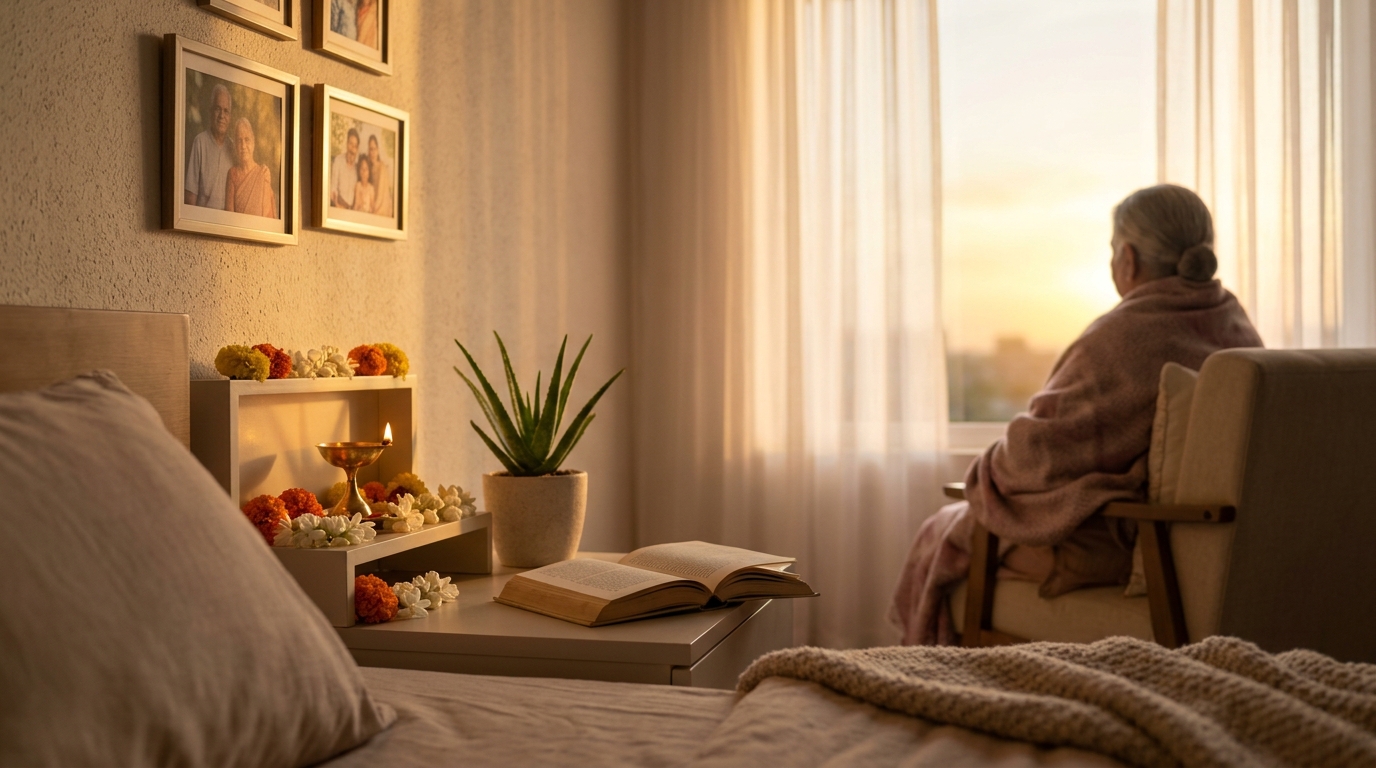
Here's a thought worth sitting with:
The room your parent lives in now is where a large part of their remaining life will happen. In it, they will read the newspapers, take their medicines, receive their friends, pray their prayers, remember their spouse, watch their favorite shows, sleep their nights, and one day — however far or near that day is — end their journey.
That room deserves reverence.
Not in a morbid sense. In a "this space is sacred because this person is sacred" sense.
Take an afternoon. Walk into their room. Notice everything — the bed, the light, the bathroom, the pooja space, the small items on their bedside table. Ask yourself: "Would I want to live here?" Then treat that answer as a starting point, not a judgment.
Improve what you can. Fix what needs fixing. Add warmth where warmth is missing. Consult them on what they need. Then keep sitting with them — really sitting, without your phone, without hurrying — as often as possible.
Vastu Shastra teaches many things. But at its deepest, most human level, it teaches this: honor the humans who share your space. Especially the ones who made your existence possible.
Set up your parent's room the way they deserve. Then live your daily life with them in it, with gratitude, with patience, with as much presence as you can offer.
Someday you'll look back and be grateful — not for the perfect room, but for the caring you brought to it.
Set up the space. Then love them in it. 🌸👵👴
Do you have an aging parent whose room could use some care? Take one weekend to walk through it with fresh eyes — and share this article with your siblings or family members. Sometimes caring for our parents is a shared responsibility that begins with a shared vision. 🙏