
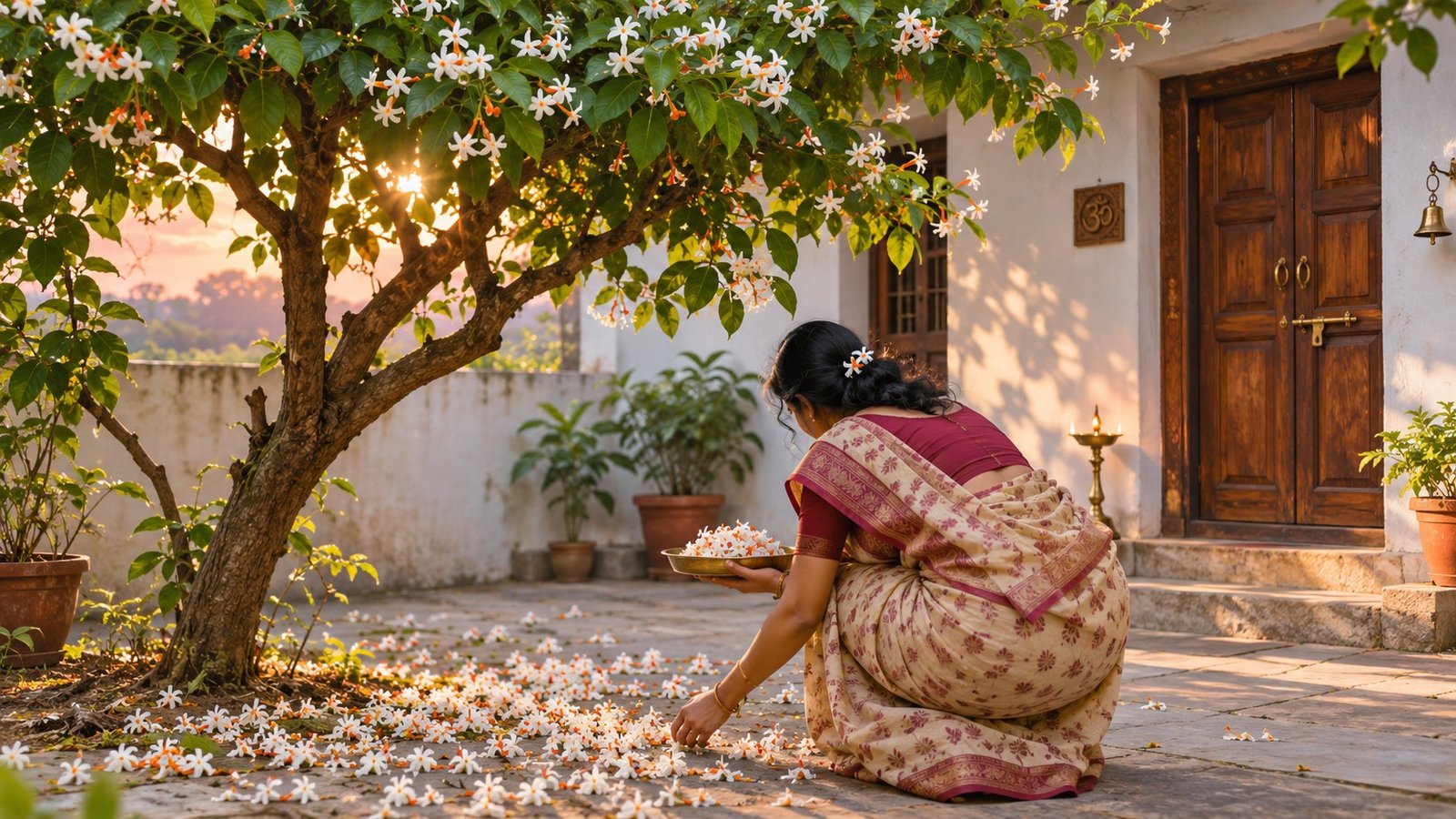
It is 5:40 in the morning. The street is still grey, the milkman has not rung his bell yet, and somewhere a grandmother is already out in the courtyard with a steel plate in her hand. She isn't plucking anything. She bends and picks up tiny white flowers with coral-orange stems, scattered across the ground like someone spilled a jar of stars overnight.
If you grew up in India, you know this scene. Depending on where you're from, you call the tree Parijat, Harsingar, Shiuli, Prajakta or Pavizhamalli. Nobody explains it, but everybody knows the rule: you don't pluck Parijat flowers. You only gather what falls.
It turns out that rule is the heart of the whole tradition, and of how Vastu treats this plant. This guide covers where to plant a Parijat, where never to plant one, how to keep one on a flat balcony, and the free daily habit that does more than any remedy you could buy.
Why Parijat Is Not "Just Another Plant"
Botanists call it Nyctanthes arbor-tristis, roughly "night flower, sad tree." The name comes from its strange habit: the flowers open after dusk, fill the air with a honeyed fragrance through the night, and drop to the ground before sunrise. By the time the sun is fully up, the branches are bare of blossom and the ground is carpeted white and orange.
To a scientist, that's a pollination strategy. Night-blooming flowers with strong scents attract moths and other nocturnal pollinators, and there's little reason to keep the flower once the night's work is done.
To the tradition, it was a story.
The tree that came from the ocean
In the Puranic accounts of the Samudra Manthan, the churning of the cosmic ocean, the Parijat is one of the treasures that rose from the waters, alongside the wish-fulfilling cow and the goddess Lakshmi herself. It was taken to Indra's heavenly garden, and it's often spoken of in the same breath as the Kalpavriksha, the wish-granting tree.
The tree Krishna brought to earth
The best-known story is domestic, almost funny. Krishna brings the Parijat down from heaven and plants it in the courtyard of his queen Satyabhama. But the tree leans over the wall, and every night its flowers fall into the courtyard of his other queen, Rukmini.
Families have told this story for centuries, half as theology and half as a joke about household politics. Its point fits Vastu well: the Parijat gives where it's devoted to, not where it's owned. That's why its flowers are gathered, never grabbed.
Why fallen flowers are pure
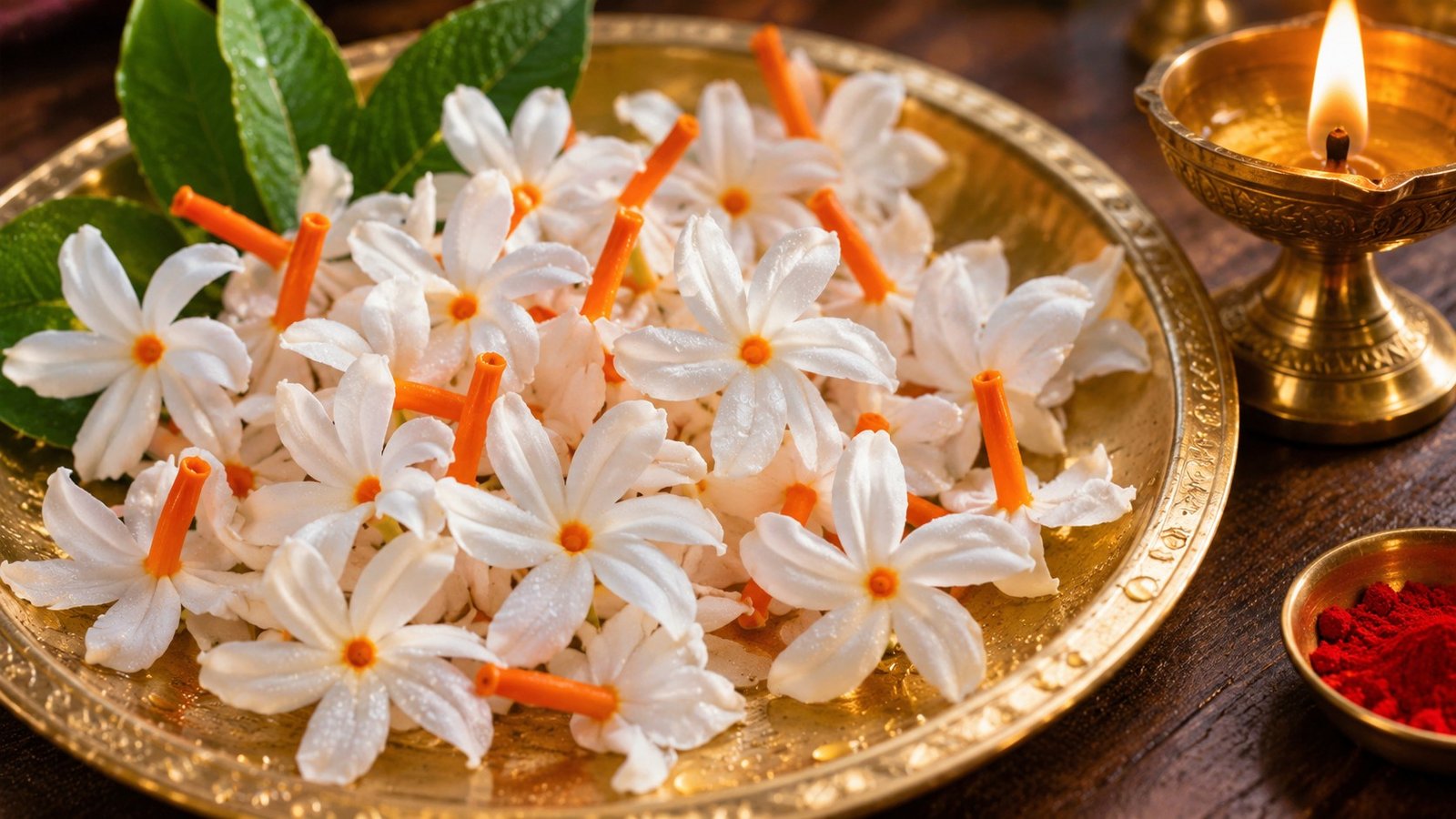
Almost everywhere else in Hindu ritual, a flower that has touched the ground is unfit for puja. Parijat is the famous exception. Its fallen flowers are considered complete offerings, often to Vishnu and Krishna, and in Bengal Shiuli blossoms are woven into the season of Durga Puja. In fact the Shiuli is West Bengal's state flower.
The flower comes to you; you don't take it. That idea, receiving rather than snatching, is what Vastu wants a Parijat to bring into a home.
What Vastu Says a Parijat Brings
Let's be honest first. Some readers will roll their eyes at the idea that a shrub can change a household's luck, and that's fair. No plant pays your EMI.
The tradition's reasoning is still worth hearing, and much of it holds up on plain observation:
- Calm in the evening hours. A Parijat blooms exactly when a household winds down. Its fragrance drifts in during dinner, conversation and sleep, which is when tempers are most likely to flare and also when they most need cooling. Traditional homes kept it close enough to smell and far enough not to crowd.
- A daily ritual of attention. Fallen flowers must be gathered or swept every morning. That one habit gets someone outside at dawn, into first light, doing something gentle with their hands. Vastu is often less about objects than about the routines the objects create.
- Lakshmi's association. Because it rose from the ocean with Lakshmi, the Parijat is linked with prosperity that arrives gracefully: abundance that doesn't come with stress attached.
- Healing traditions. In Ayurveda, Parijat leaves have long been used in home preparations, especially for fevers and joint pain. Treat that as heritage, not prescription, and check with a qualified practitioner before using any plant medicinally.
So the Vastu view of a Parijat is this: a living reminder of grace, placed where the household can see it, smell it and tend it every day. Placement matters because it decides whether the tree becomes a joy or a chore.
The Best Direction to Plant a Parijat
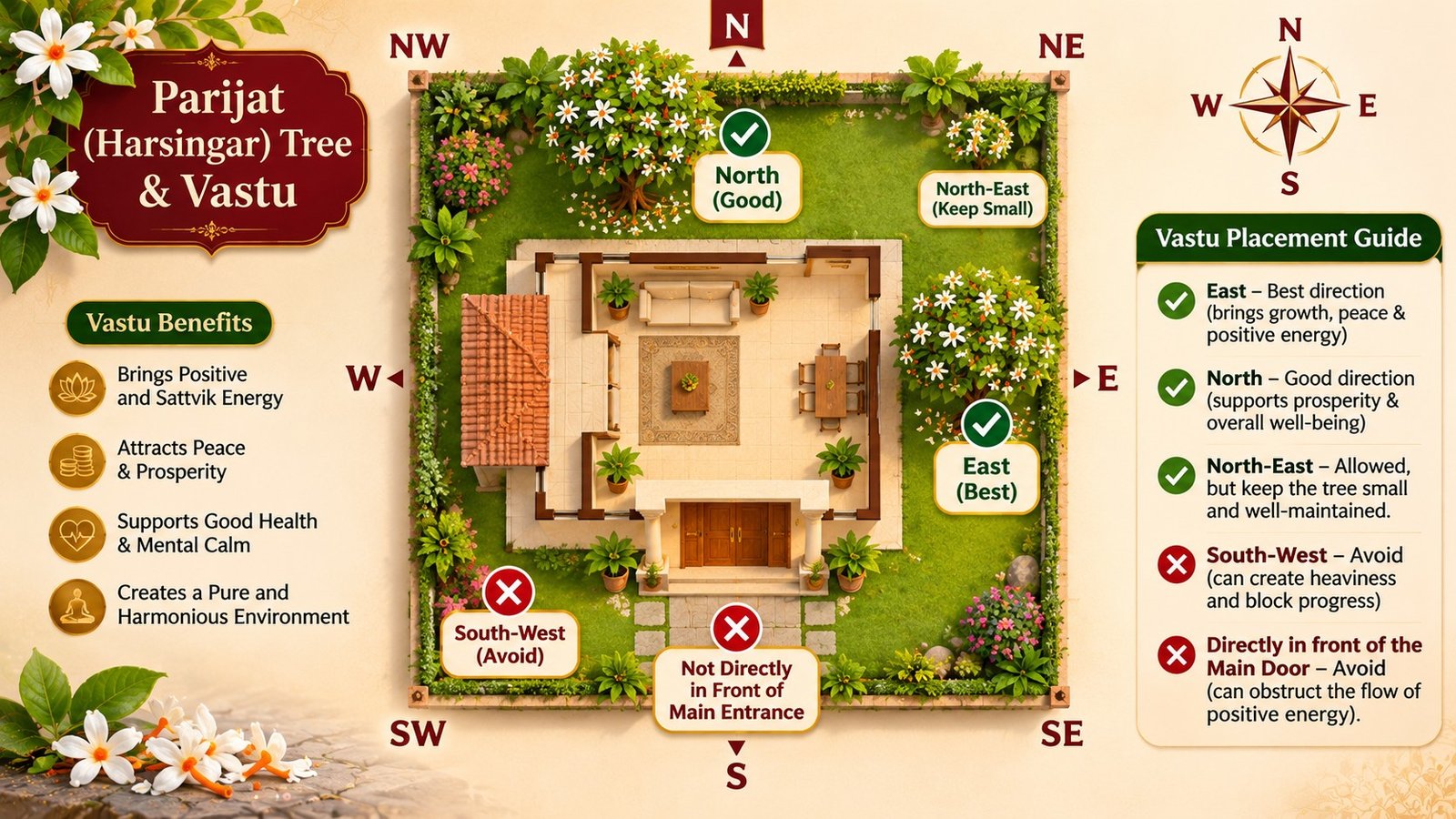
East: the first choice
The East belongs to the rising sun and to new beginnings. A Parijat in the East of your garden or compound gets gentle morning light, which suits it, and drops its flowers just as the eastern sky brightens. You step out at sunrise, face the dawn and gather flowers for the morning prayer. The geometry and the ritual line up perfectly.
North: for calm prosperity
North is Kubera's direction, the zone of wealth and opportunity. Vastu wants the North kept open, light and uncluttered, which is exactly why a Parijat works here. It's a modest tree, usually kept between 10 and 15 feet in home gardens, and it doesn't create the heavy mass that would weigh down a northern zone. A Parijat here is said to support steady, peaceful financial flow.
North-East: yes, but keep it light
The North-East, or Ishan, is the most sacred corner of any plot, the divine zone that should stay clear, open and bright. Because the Parijat is so closely tied to worship, many families like it here, and it can work, with conditions:
- Keep it pruned and small. It should never become a dense canopy that shades the North-East.
- Plant it a good distance from the house wall, never pressed against it.
- Don't let the fallen flowers pile up. A sacred zone with rotting blossoms is the opposite of what you want.
If your North-East holds your prayer space or main openings, a Parijat in the East or North is often the safer choice.
North-West: an acceptable option
The North-West, the Vayu zone, governs air, movement and relationships. A Parijat here gets good airflow and can soften a zone that sometimes carries restlessness. It's not the classical first choice, but it's a perfectly good one, especially on a North-West balcony.
Where You Should Never Plant a Parijat
❌ Directly in front of the main door
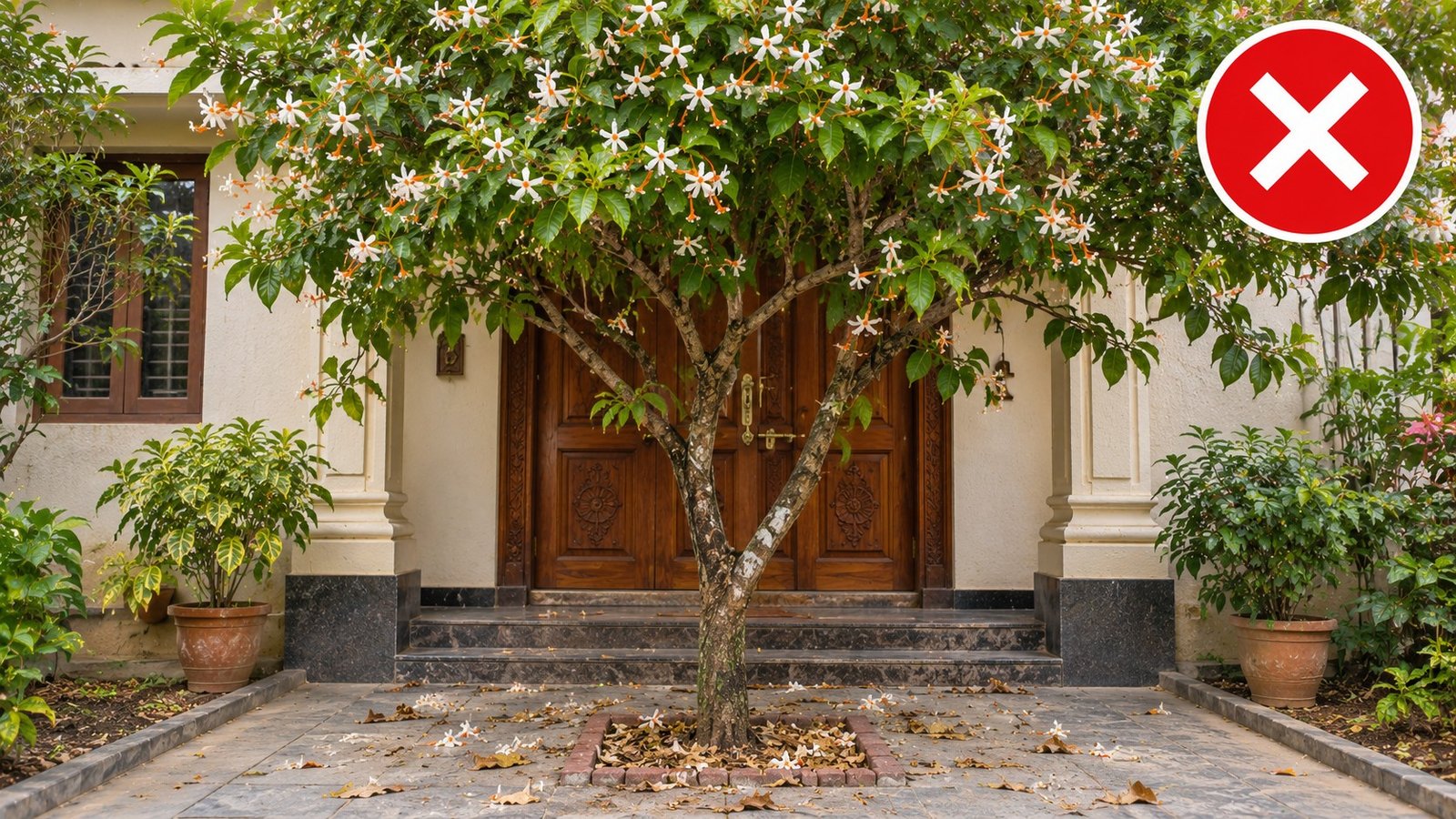
Vastu calls any obstruction in line with the entrance dvara vedha: a pillar, pole, tree or even a big pot blocking the main door's path. However sacred the plant, it shouldn't stand squarely in front of your entrance, where it blocks the flow of energy and people. Move it to one side of the path, or to the East or North of the compound.
❌ South-West, as a feature tree
The South-West is the householder's zone of stability. It wants weight: tall heavy trees, solid walls, the heaviest furniture. A delicate flowering shrub doesn't serve this zone. If you have a South-West garden, plant something sturdy there and put the Parijat elsewhere.
❌ South-East, crowding the kitchen
The South-East is Agni's zone, ideally home to the kitchen. A Parijat's soft, cooling, devotional quality doesn't really fit fire. It won't spoil your kitchen, but it's not the right home for the tree.
❌ Inside the house
The Parijat is a tree. It needs sun, rain, wind and room for its roots. Keeping it in a dark interior pot, or worse, a bedroom, means a sickly plant. In Vastu a struggling plant is worse than no plant at all.
Living in a Flat? Here's Your Balcony Parijat Plan
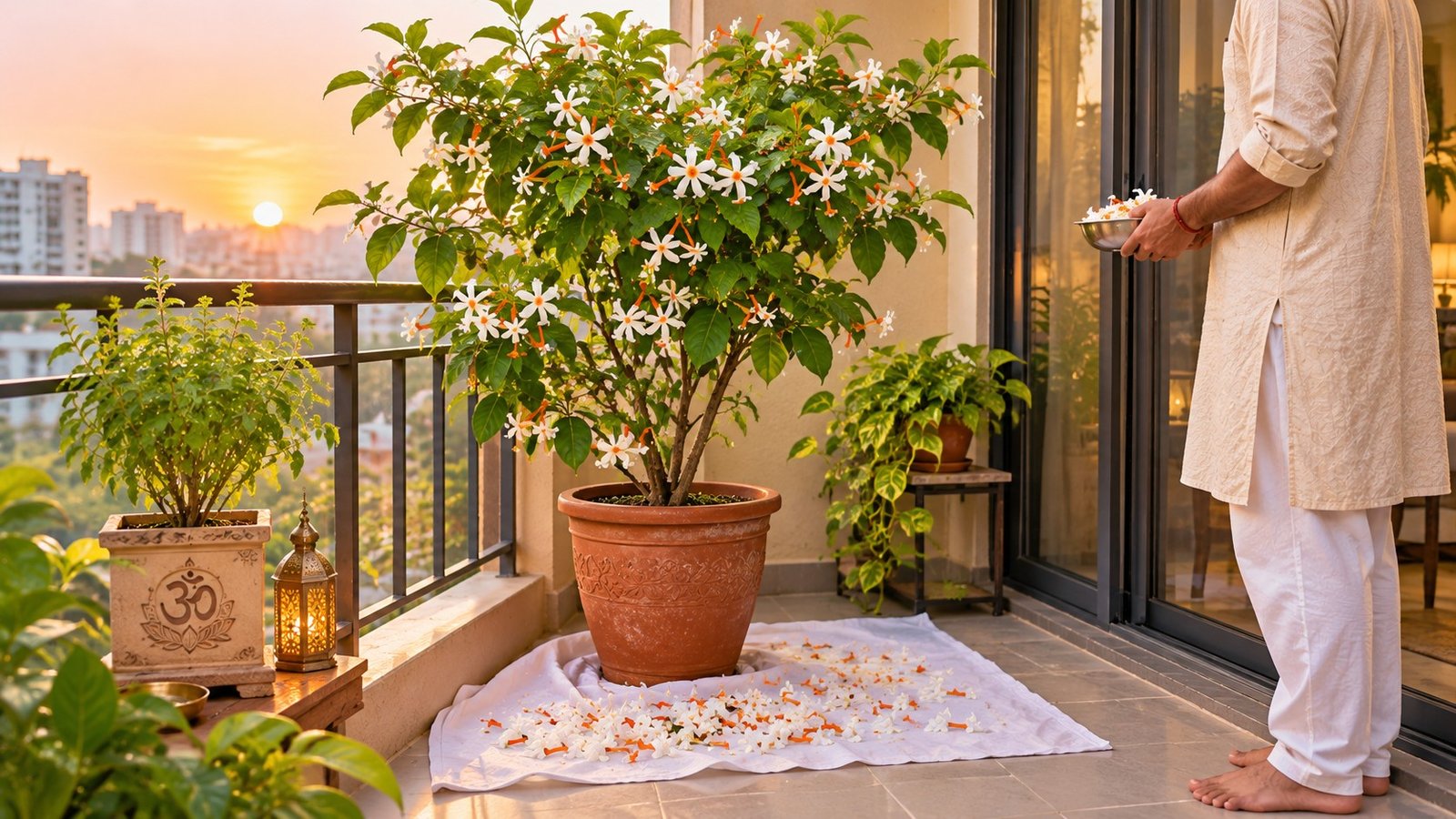
Most of our readers don't have courtyards, and that's fine. Plenty of Parijats flower happily on Mumbai and Bengaluru balconies.
Balcony direction: East or North balconies are ideal, North-West is acceptable, and a South-West balcony is best avoided for this plant.
Pot size: Go big. A pot at least 18 inches wide and deep, with proper drainage holes. A cramped pot means a stunted, stressed plant.
Sunlight: It needs at least 4–6 hours of direct sun. Without it you get leaves but few flowers.
Pruning: Trim it after the flowering season ends so it stays a compact, balcony-sized shrub instead of a gangly mess.
Morning ritual, flat edition: Spread a clean cloth or a wide tray under the plant at night. In the morning the night's flowers are waiting, clean and ready for your puja corner. Nothing to sweep off the floor.
One rule above all: if the plant dies, don't leave it standing. A dried, dead plant on the balcony is one of the most common Vastu mistakes in apartments. Remove it, thank it and start again.
The ₹0 Fix: Gather at Dawn
Here is the single most powerful thing you can do with a Parijat, and it costs nothing.
Gather the fallen flowers every morning before or around sunrise, and offer them.
Offer them at your home altar, float them in a bowl of water by the entrance, or place a handful at the feet of an idol. If you don't have a prayer practice, just put them in a small bowl of water on your dining table, where their fragrance lasts a few hours.
What you should never do is let the flowers lie on the ground for days, browning and rotting. In Vastu, decaying organic matter near the house creates stagnation, the opposite of the Parijat's gift. Fresh flowers are grace; rotting flowers are neglect.
If you already have a Parijat and change nothing else after reading this, start gathering at dawn. That one habit turns a tree into a ritual.
📋 Save This: The Parijat Vastu Checklist
📲 Screenshot this and send it to the family member who keeps the garden:
THE 7 PARIJAT RULES
- 🌅 Plant it in the East or North: best for peace and prosperity.
- 🙏 North-East works only if the tree is kept small and away from the wall.
- 🚪 Never directly in front of the main door.
- 🌸 Never pluck. Gather only what falls.
- 🧹 Collect the flowers by sunrise and never let them rot.
- ☀️ Give it 4–6 hours of sun, never a dark corner indoors.
- 🍂 A dead Parijat must be removed, not left standing.
Bonus planting tips:
- Best season: The monsoon, roughly July to September, when the soil is soft and new roots take quickly.
- Best day: Many families plant sacred trees on a Thursday or another day they consider auspicious, with a small prayer. Follow your own family custom.
- Companions: A Tulsi in the North-East and a Parijat in the East make a classic, harmonious pair. See our complete Vastu plants guide for more pairings.
Parijat as a Gift: One of the Kindest You Can Give
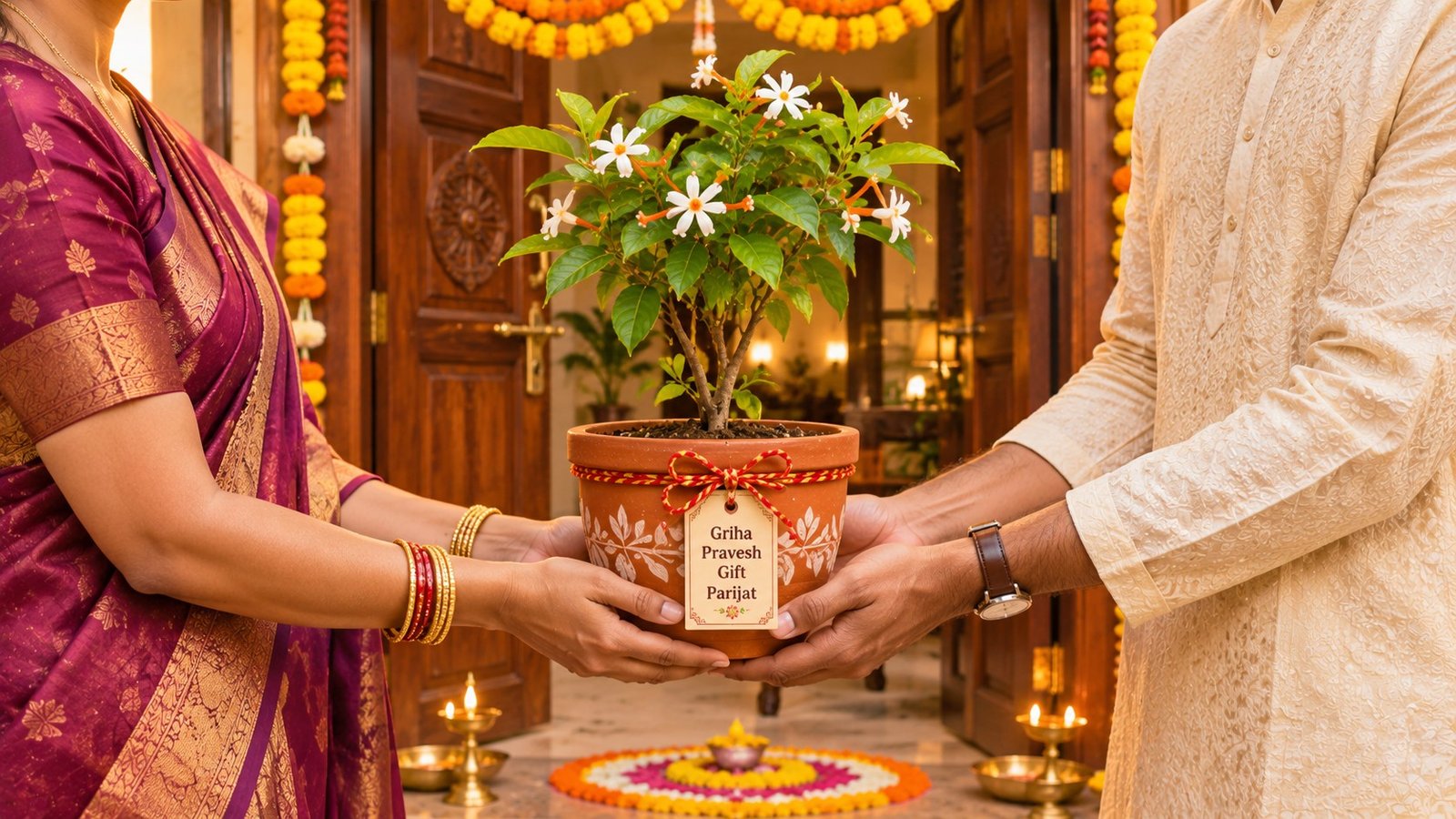
A Parijat sapling is one of the most meaningful gifts for a housewarming, a wedding or a new beginning. It's living, sacred, grows with the family and gives something back every single morning.
If you're gifting one to a couple setting up their first home, it pairs beautifully with the ideas in our newlyweds' first home Vastu guide. For the wider etiquette of what to give and what to avoid, read our Vastu gifts guide.
A small note: gift a healthy sapling in a proper pot, not a wilted one in a plastic bag. The gift is the promise of flowers, so make the promise a good one.
Common Parijat Vastu Questions
Can I keep a Parijat if I don't do puja? Yes. The tradition is devotional, but the tree's gifts of fragrance, beauty and a calm morning routine work for anyone. Gathering the flowers can simply be a mindful habit.
My Parijat is planted in the South-West. Should I uproot it? If it's healthy and established, don't panic or uproot it carelessly. Strengthen the South-West in other ways with heavy planters, solid furniture or a wall feature, and if you're planting new, choose the East or North.
Is it okay to plant Parijat near the boundary wall? Yes, especially the East or North boundary, as long as it isn't blocking the main gate and its roots aren't pressing against the house's foundation.
Why does my Parijat flower so little? Usually it's not enough sun, a cramped pot or too much water. Move it to brighter light and let the soil dry slightly between waterings.
📐 Not Sure Which Side of Your Home Is Truly East?
A Parijat's power depends almost entirely on where it stands, and most of us have only a vague idea which corner of our home is the real North-East.
We built a free tool where you can upload your floor plan and instantly see it mapped according to proper Vastu directions, so you know exactly which balcony, corner or garden patch is the right home for your Parijat.
👉 Upload your floor plan and find your Parijat's perfect spot in 30 seconds
Just a photo or scan (PNG, JPG, JPEG). The tree knows where to drop its flowers; now you'll know where to plant it.
Final Thoughts
There's something quietly radical about a tree whose flowers are holiest only after they've fallen. Everything else in modern life tells us to reach, grab and take. The Parijat tells us to wait, rise early and receive.
That's really what Vastu asks of us: not to force the home into luck, but to arrange it so grace has somewhere to land. Plant your Parijat in the East or North, keep it healthy, keep the ground clean and step outside each morning to gather what the night has left you.
Some trees give you shade. The Parijat gives you a reason to wake up early.
🌸 Shubham Bhavatu. May your mornings always smell of Harsingar. 🙏